
Quilting
Square Quilt Patterns: Patch Sizes, Grids and a 42-Inch Top
The short answer
Count the grid from finished patch sizes, then add the seam allowances to each cut square.
Last updated October 2026
What's covered7
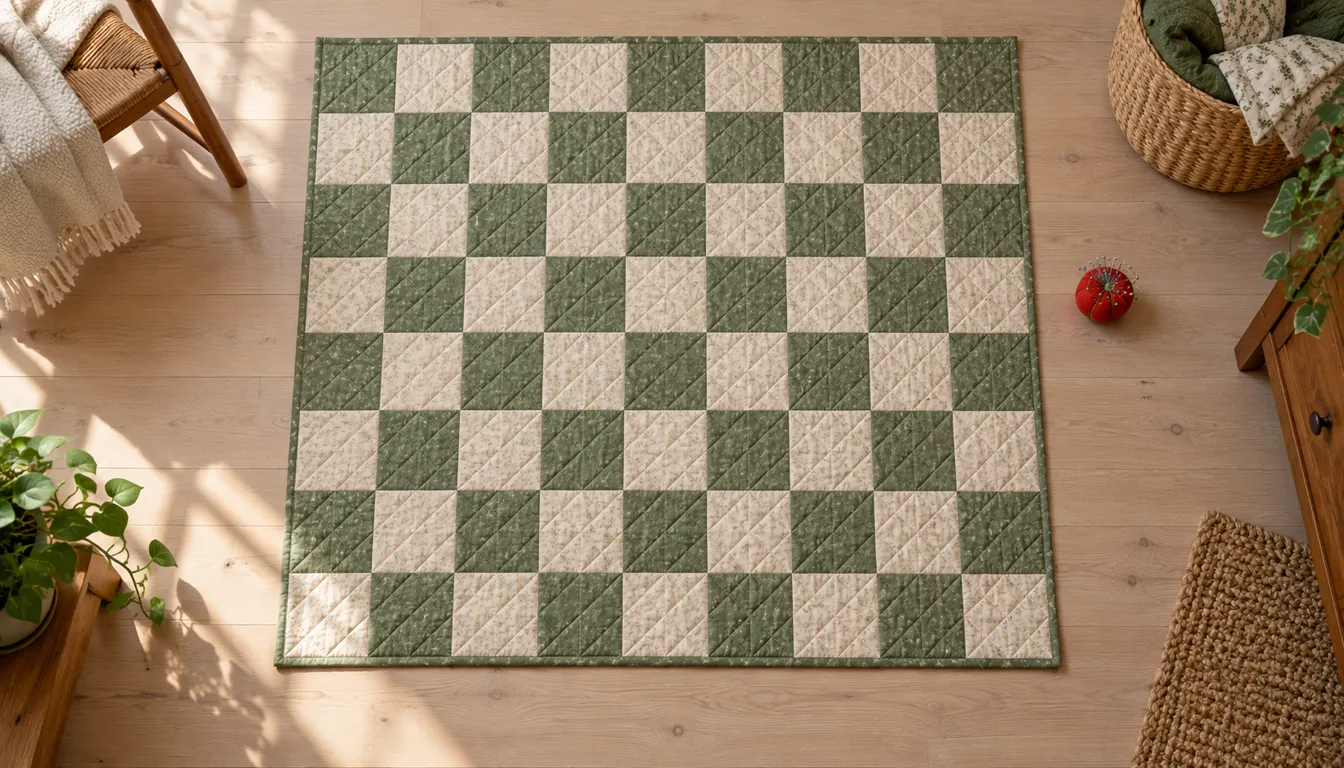
You can make a quilt from square patches without making the whole quilt square. For a top with equal width and height, use the same number of equal squares across and down. The 42-inch project below uses a seven-by-seven grid of 6-inch finished patches in two colors.
Choose the final width first, then divide it by the number of squares across. Add 1/2 inch to each square's finished size when using 1/4-inch seams. Count every patch by row before cutting. A square outline still needs a finishing plan for its back, batting and edge, just like a rectangular quilt.
Square patches and square tops are different choices
A top built from squares can be long and narrow. A square top can contain strips or triangles. Decide whether you want square patches, a square outline or both. Then choose a cutting chart that fits that goal.
Our quilting guide explains the cloth and layers for either route. For this project, both meanings apply: the top is square and every patch is square. That gives you one simple cut size and the same number of patches across and down.
Measure the space where the quilt will sit and compare it with this 42-inch top. If you need more coverage, adjust the number or size of patches before cutting. Adding a border later is another design step with its own fabric count.
Calculate square quilt patterns from a grid
The main rule is finished square size x squares across = finished width. Use the same rule for height. The extra seam allowance belongs on the cut size, not in the finished total. This distinction prevents a common overestimate.
| Grid | Finished patch | Finished top | Cut patch |
|---|---|---|---|
| 5 by 5 | 6 inches | 30 inches square | 6 1/2 inches |
| 6 by 6 | 6 inches | 36 inches square | 6 1/2 inches |
| 7 by 7 | 6 inches | 42 inches square | 6 1/2 inches |
| 8 by 8 | 6 inches | 48 inches square | 6 1/2 inches |
Scroll for more →
All figures in this table use 1/4-inch seams. Add 1/4 inch at each side of a patch when calculating its cut size: finished size plus 1/2 inch. The table gives dimensions before any shrinkage from quilting or washing.
Cutting list for the 42-inch checkerboard
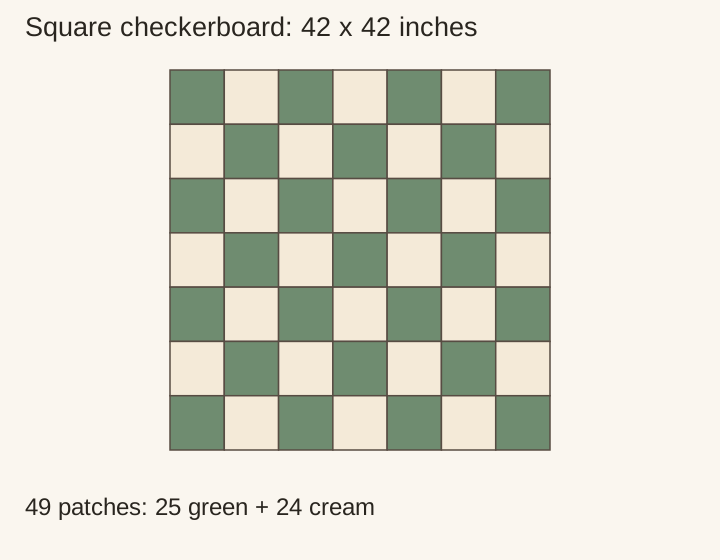
Use seven columns and seven rows, giving 7 x 7 = 49 squares. Start the upper-left corner with green, then alternate green and cream across every row. Start row two with cream. Continue alternating the row starts down the top.
The four odd-numbered rows each use four green and three cream squares. The three even-numbered rows use three green and four cream squares. Green total: 4 x 4 + 3 x 3 = 25. Cream total: 4 x 3 + 3 x 4 = 24.
Cut 25 green and 24 cream squares at 6 1/2 inches. At a measured usable fabric width of 40 inches, six squares fit across a strip, since 6 x 6.5 = 39 inches. Green needs five strips, yielding 30 squares. Cream needs four strips, yielding exactly 24.
Those strips use 32 1/2 inches of green length and 26 inches of cream length. Divide by 36 for about 0.90 yard and 0.72 yard before extra for preparation and squaring. If the fabric cannot supply 39 usable inches, the six-across cutting plan needs a new calculation.
Check the first row before joining seven
Lay out the full grid before sewing so you can judge the contrast. Put a label at the left of each row. Join the seven patches in row one, keeping the sequence green-cream-green-cream-green-cream-green.
The unfinished row should measure 42 1/2 inches long. Seven cut squares total 45 1/2 inches; six joins use 3 inches. The row height remains 6 1/2 inches. Check that length before making the remaining six rows.
Join the rows in order. The unfinished top should measure 42 1/2 inches square. Compare both diagonals as well as the sides on a flat surface. A top that twists or has uneven row ends needs inspection before you add the next layers.
Square quilt patterns for large prints
For a picture print, the visible patch will be 6 inches square. Make a 6-inch paper window and place it over the fabric. Leave the surrounding 1/4-inch seam allowance outside the window when marking the cut size. A flower that fits inside 6 1/2 inches may still be clipped by a seam.
If matching a motif requires shifting every cut, the simple strip yield above no longer applies. Count the actual full motifs you can cut instead. Keep a few paper squares on the cloth to test their positions before using the blade or scissors.
For mixed large and small squares, use the patchwork quilt patterns guide. For equal squares built into repeated small blocks, try patch quilt patterns beginners can sew. Their assembly plans answer different layout questions.
Make a square plan easier to finish
Divide the work into rows you can complete in one session. Keep the cut pieces in a shallow tray or separate labeled groups. Our quilting routine guide helps you set a small next task instead of leaving the whole top loose on a table.
The Scissortail block library is a visual browsing route if you want to replace the plain patches with pieced blocks later. Replacing a plain 6-inch patch means the new block must also finish at 6 inches. Its internal cuts will need their own plan.
Check your sewing machine's manual for the setup for piecing this top. Compare beginner quilting machines when you need help choosing controls and fabric handling. Decide how you will quilt the layers before enlarging the top.
Verdict
Plan the quilt's outline and its patches before calculating the grid. For this 42-inch square quilt, cut 49 equal patches with 25 in the starting color. Sew and measure one row before you repeat the process across the whole top.
FAQ
How many squares do I need for a square quilt?
Multiply the number across by the number down. A seven-by-seven top uses 49 patches. The finished patch size determines the final width.
Can I use precut squares?
Yes, if their actual size matches the cutting plan. Measure several first. A 5-inch cut square finishes at 4 1/2 inches with 1/4-inch seams.
Why does an odd checkerboard need unequal color counts?
The starting color appears at both ends of each odd row. In the seven-by-seven example, that adds up to 25 green and 24 cream patches.