
Quilting
Patch Quilt Patterns Beginners Can Sew: Nine-Patch Plan
The short answer
A nine-patch uses nine equal squares in three rows. Make one accurate block, then repeat it into a measured top.
Last updated October 2026
What's covered7
A nine-patch is a useful first patchwork block: nine equal squares joined in three rows. The plan below repeats it 24 times for a 36-by-54-inch top. You will practice counting patches, keeping colors in order and matching seams, all with straight cuts.
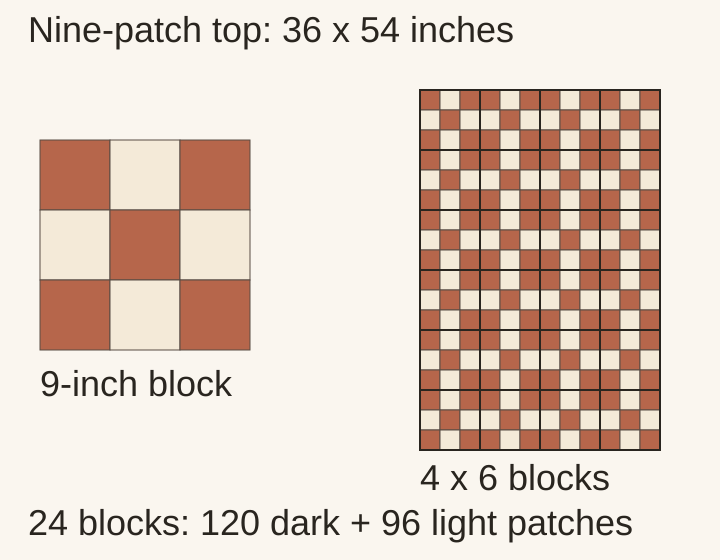
Cut all patches at 3 1/2 inches and use 1/4-inch seams. Each patch finishes at 3 inches, so a three-by-three block finishes at 9 inches. Make one block and check that it measures 9 1/2 inches on the table. Then repeat the block in four columns and six rows.
What makes a patch quilt easy to follow?
Equal patch sizes make the cutting list clear. A repeated block lets you practice one join order many times. In a nine-patch, every seam runs from one outside edge to another. You can lay the whole block out before sewing and see exactly which square comes next.
Visit the quilting guide for the cloth and finishing plan. For this top, choose one dark fabric and one light fabric. A third print can be added later, but a two-color sample makes an incorrect square easier to see.
Put dark fabric at all four corners and in the center, with light fabric in the four side positions. Each block needs five dark and four light patches. Repeat that arrangement in every block so the design stays clear.
Count the patches before cutting
There are four blocks across and six down: 4 x 6 = 24 blocks. Each needs five dark patches, so cut 24 x 5 = 120 dark squares. Each needs four light patches, so cut 24 x 4 = 96 light squares. The full top uses 216 patches.
| Part | Cut size | Count | Finished size |
|---|---|---|---|
| Dark patch | 3 1/2-inch square | 120 | 3-inch square |
| Light patch | 3 1/2-inch square | 96 | 3-inch square |
| Joined block | 9 1/2-inch square unfinished | 24 | 9-inch square |
Scroll for more →
At a measured usable width of 40 inches, eleven cut squares fit across one strip: 11 x 3.5 = 38.5 inches. Eleven dark strips yield 121 patches and use 38 1/2 inches of length. Nine light strips yield 99 patches and use 31 1/2 inches. The spare pieces give one dark and three light extras.
The dark cut length is 38.5 / 36 = about 1.07 yards. The light cut length is 31.5 / 36 = 0.875 yard. Add extra for your preparation and squaring needs. Recalculate if your usable width is less than 38 1/2 inches.
Sew the first nine-patch block
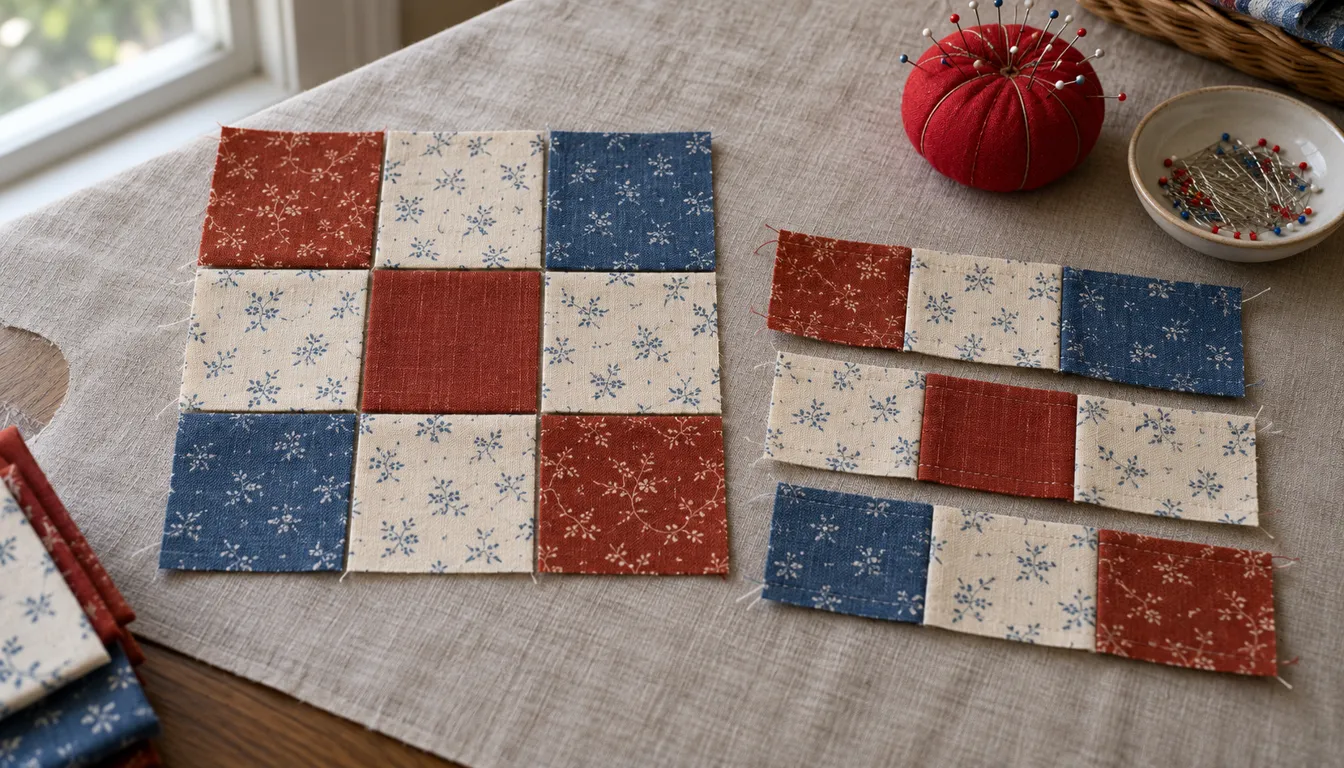
Arrange three rows: dark-light-dark, light-dark-light, dark-light-dark. Join the squares within each row. Before the rows meet, each should measure 9 1/2 by 3 1/2 inches. Three cut widths total 10 1/2 inches; two seams use a total of 1 inch.
Join the top row to the middle row, matching the two vertical seams. Add the bottom row. The block should measure 9 1/2 inches square. Check it on a flat surface and compare opposite sides. Save a photo of the correct block beside your cut stacks.
If a row is wrong, fix its color order before it enters the block. If the block is too small, measure the patches and seam allowances. Do not trim the remaining loose squares to copy a sewing error. The plan depends on all blocks reaching the same outer size.
Build blocks in groups you can count
After the first block passes, prepare the other 23. Lay out several blocks at a time on a clear surface. Keep each set of nine together. That avoids using an extra center square from the next block and discovering a shortage at the end.
You can make all dark-light-dark rows first, then the light-dark-light rows. For the whole top, you need 48 of the first row type and 24 of the second. Check those counts against the patch totals before starting a long batch.
Keep one accurate row as a reference. Compare each new group with it, then measure with a ruler. Rows can line up neatly in a stack yet all be slightly short. Each sewn row needs to measure 9 1/2 by 3 1/2 inches before you join it into a block.
Join a 36-by-54-inch top
Arrange 24 finished blocks in four columns and six rows. Keep the corner-color layout the same. Join four blocks for the first top row. The unfinished length is 4 x 9.5 - 3 x 0.5 = 36.5 inches. Its height is 9 1/2 inches.
Make the other five rows, then join them in order. The top should measure 36 1/2 by 54 1/2 inches, including a 1/4-inch seam allowance along each outside edge. The finished design size comes from 4 x 9 = 36 and 6 x 9 = 54 inches.
Spread the top out before the final join. Nine-patch layouts contain many repeated squares, so a wrong center can be hard to spot up close. Look along each block row, then each block column. Check the light side patches as well as the dark corners.
Choose another patch layout when you want variety
For mixed-size pieces, read our patchwork quilt patterns guide. It explains layouts where different patch sizes must fit the same row. Keep that extra sizing task for a later project if equal squares are still new.
For a lower patch count, the square quilt patterns page starts with whole squares rather than repeated nine-patch blocks. For a block sample instead of a whole top, use beginner quilt blocks.
The Lo & Behold patchwork-squares page shows another way to plan a quilt from a square grid. Follow its cutting and assembly instructions together if you choose that project. Keep the measurements for each pattern on its own working sheet.
Verdict
Repeat a nine-patch to practice counting and matching with the same few seams. Measure the first block before making the batch, then check the first top row before joining more. Compare beginner quilting machines if you need a machine with controls you can manage at that pace.
FAQ
Is a nine-patch quilt suitable for beginners?
Yes, when the squares are large enough to handle and the pattern uses straight rows. Check one block before cutting or sewing the whole batch.
Can I use scraps for the dark patches?
Yes. Keep the planned cut size and use scraps that read darker than the light fabric. You still need 120 dark patches for this top.
Why does my nine-patch measure 9 1/2 inches instead of 9?
The 9-inch figure is the finished size. The extra 1/2 inch supplies the outer seam allowances for joining the block into the top.