
Quilting
Simple Quilt Patterns: Four Layouts for a First Finish
The short answer
Start with large squares or bars. A small top with one cut size makes the first rows easier to measure and repeat.
Last updated October 2026
What's covered7
Simple quilt patterns use few piece sizes, clear rows and seams you can repeat. Large squares, bars, four-patch blocks and rail fence blocks are useful starting choices. For a first finish, choose the layout with the fewest new steps and a size you can handle on your table.
A plain square grid is a good first quilt because you can see every piece before sewing. Use a consistent seam allowance and check the first row against the plan. Choose fabric with enough light and dark contrast to keep the layout clear. Add triangles later, once straight rows stay the same length from one end to the other.
Beginner easy quilt patterns: compare the seams
The easiest design for you depends on the part of sewing you already know. If cutting is new, fewer large pieces help. If you can cut strips but struggle with matching corners, a bar layout can reduce the number of meeting points. A small top also makes mistakes easier to find.
Start with our quilting guide for the materials each stage needs. Then compare these four layouts by the skill they ask you to practice.
| Layout | Main task | First check |
|---|---|---|
| Large squares | Join equal pieces into rows | All cuts have the same size |
| Bars | Keep long seams even | Strip width stays constant |
| Four-patch | Match one center seam | Block measures correctly |
| Rail fence | Rotate strip blocks | Stripe direction follows the map |
Scroll for more →
A busy print can make both the seams and the block outlines hard to see. Use one plain or quiet fabric in the first sample. You will be able to see the join and judge whether the colors work.
Beginner quilt patterns: start with a small target
Choose a size you can spread flat on your work surface. The rectangular quilt below finishes at 35 by 45 inches. Measure the place where you will use it before deciding whether to add more rows.
For all the cutting in this plan, use 1/4-inch seams. A 5-inch finished square starts at 5 1/2 inches. The extra 1/2 inch supplies two 1/4-inch allowances. Keep finished and cut sizes in separate columns on your project sheet.
If you want help choosing a machine, use beginner quilting machines. If you own a SINGER Patchwork 7285Q, use the SINGER Patchwork guide to check its controls and accessories. Pick the project before adding tools for a method you may not need.
Sew a rectangular quilt: 35 by 45 inches
Use seven squares across and nine down. The total is 7 x 9 = 63 squares. Cut all 63 at 5 1/2 inches. For a three-color layout, cut 21 each of cream, blue and gold. That equal split makes the cutting list easy to check.
Lay out the first row as cream, blue, gold, cream, blue, gold, cream. Start row two with blue and row three with gold. Repeat those three row starts three times. Across all nine rows, each color appears 21 times.
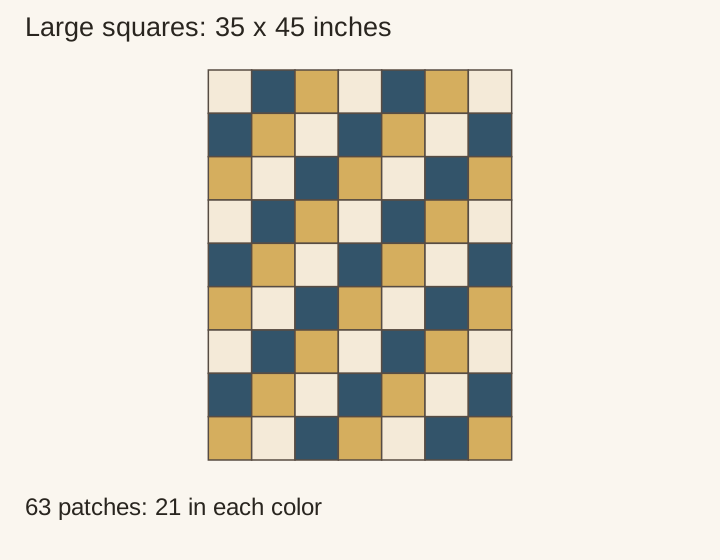
At a measured usable width of 40 inches, seven 5 1/2-inch squares fit across one strip because 7 x 5 1/2 = 38 1/2 inches. Three strips per color yield 21 squares. Each color needs 3 x 5 1/2 = 16 1/2 inches of fabric length for those cuts. Divide by 36 to get about 0.46 yard per color before extra for preparation and squaring.
That yield depends on having the full usable width after removing the edges you cannot use. If your fabric is narrower, place paper squares across it or recalculate before buying. Measure the completed top before cutting backing and batting, and calculate binding for its perimeter.
Sew easy quilt patterns one row at a time
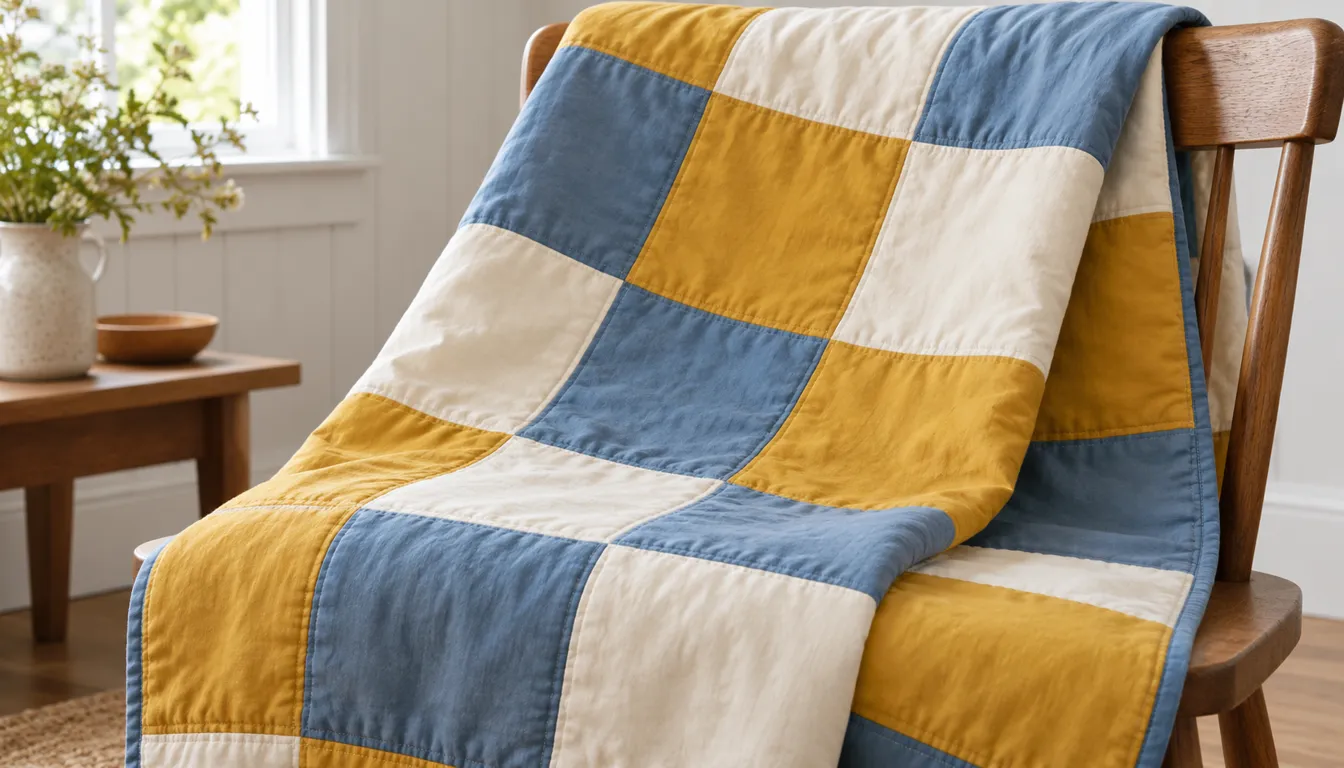
Join two squares right sides together. Add the next square at the right edge until row one has seven. Keep the layout photo beside you. A short row can be turned around on the way to the machine, which reverses a one-way print.
The first row should measure 35 1/2 by 5 1/2 inches. The length calculation is seven cut widths minus six joins: 7 x 5.5 - 6 x 0.5 = 35.5 inches. That gives you a useful check before the next eight rows.
Press and check each row on a flat surface. Keep row labels at the same end. Join rows in order, matching the square seams. The top's unfinished measurement is 35 1/2 by 45 1/2 inches. Its outer 1/4-inch allowances account for the extra half inch in each direction.
Quilt patterns for beginners: which layout comes next?
Move to four-patch blocks when you want more color changes without diagonal seams. Four equal small squares make one block. You can learn the center join on a single block, then repeat it. Our beginner quilt blocks page gives a short skill ladder.
Try the rail fence pattern if strips appeal to you. The block uses straight joins, but rotating the blocks changes the path through the quilt. It teaches you to follow a layout map as well as keep a seam width.
Keep triangles for a project where you have time to trim units. A star can look simple from a distance while hiding several kinds of cut. Compare quilt patterns to find a design you like with assembly steps you can follow.
Fix the first error before it becomes a batch
If a row is too short, measure its pieces. If they are all cut correctly, inspect the joining allowance. A wide seam takes more cloth from each square. The effect grows across a row, so one small seam difference can matter at the far edge.
If a single square is wrong, replace that square. If one row is reversed, unpick the join that caused it while the top is still small. Do not force two different row lengths together and hope the quilting will remove the extra fabric.
Leave borders until you have measured the assembled top. A border can frame the colors, but it adds more cloth and longer seams. For your first finish, the plain grid is already a complete design. Plan the quilting and binding as their own steps.
Verdict
Choose simple quilt patterns like the large-square plan when you want one clear cutting size and an easy row check. Choose four-patch or rail fence next to learn a new skill through repetition. Finish the small version before adding more rows or a wide border.
FAQ
What is an easy quilt pattern with no triangles?
A whole-square grid uses only equal squares and straight joins. Bars and four-patch blocks are other useful choices when you want to keep diagonal cuts out of the first project.
Can I make an easy quilt from scraps?
Yes, if the scraps are large enough for the required cuts and have a similar feel. Sort them by usable size before choosing the pattern.
Does a larger block make a quilt easier?
It reduces the number of pieces for a given top size. You still need accurate cuts, steady seams and room to hold the joined rows.