
Quilting
Free Quilt Patterns: Publisher Libraries and Download Checks
The short answer
Use a publisher library, open the complete file and check its tools, cuts and assembly order before buying fabric.
Last updated October 2026
What's covered7
Free quilt patterns are useful when they include a full cutting list, finished size and clear assembly steps. Start with a publisher's own library, then read the individual download before buying fabric. Pick by the method you can follow, rather than by the cover photo alone.
Choose a complete pattern with a small number of piece sizes and a row diagram you understand. Check whether the file needs a special cutting tool, an account or extra instructions. Save the whole file and its publisher link. Make a sample block before cutting the rest, even when a pattern is marked easy.
Where to find free quilting patterns
Browse these publisher libraries for a project you want to sew. Choose a pattern, then read its fabric and tool requirements before downloading the file.
| Publisher library | Useful starting point | Check before sewing |
|---|---|---|
| Fat Quarter Shop | Browse free quilt projects | Fabric format and included sizes |
| Moda Fabrics | Browse project sheets and quilt designs | Required fabric and any templates |
| Robert Kaufman | Look through quilt patterns | Exact download and construction method |
Scroll for more →
The Fat Quarter Shop free-pattern library brings many projects together for browsing. The Moda library includes quilt projects alongside smaller sewn items. The Robert Kaufman pattern library is another publisher source to browse directly.
Use our quilting guide to choose fabric, batting and binding for your project. A download's file size or bright photo tells you little about how hard its seams will be. Open the instructions and look at the pieces.
Quilt patterns free: what to check before saving
A useful file should say how large the finished top will be. It should tell you whether a square size is cut or finished. Look for a seam allowance and enough diagrams to understand the order of joins. Count the pages and check that no step refers to a missing sheet.
Look for special requirements near the start. Some designs use a particular die, template or ruler. Others can be cut with a plain ruler. Those are different routes to the same kind of project. Choose the route you can follow with your own tools.
Save the download with a short project name and keep its web address in the same folder. You can return to that page to check for corrections. Print a working copy for written reminders, leaving the saved PDF unmarked.
Choose free quilt patterns by skill
An easy label is only a starting clue. A pattern with plain squares has fewer kinds of joins than one with curved pieces. Small patches can still ask for careful seam control. Large blocks may be easier to handle, though the completed top takes space.
Read one block's assembly steps aloud. If you cannot tell which edge joins next, set that file aside until you have tried the method on scraps. For a first choice with no triangles, use simple quilt patterns. For diagonal blocks, learn the unit first in our half-square triangle guide.
Check the fabric format too. A pattern written for strips may waste cloth if you start with small squares. A fabric bundle's piece count does not prove that its pieces are the right size. Compare the cut list with the cloth you actually have.
Free checkerboard mini: 20 by 24 inches
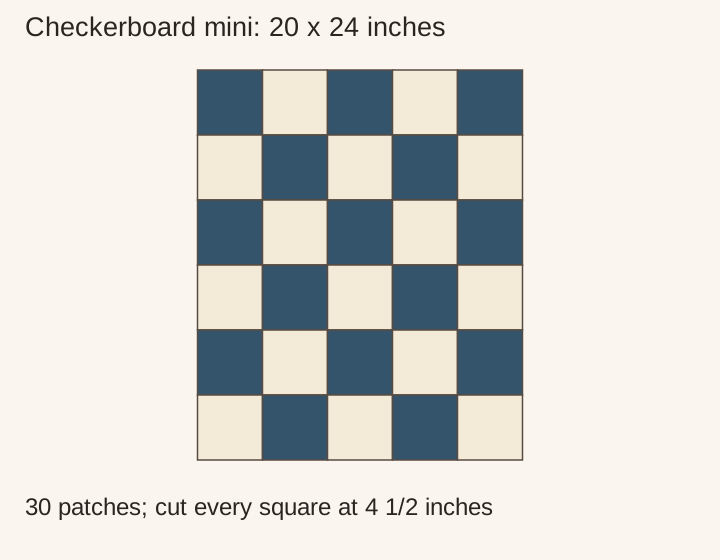
Practice following a cutting chart with this small checkerboard top. It uses 30 whole squares in five columns and six rows. Each square finishes at 4 inches. Cut 15 dark and 15 light squares, then lay them out before sewing.
Cut every square at 4 1/2 by 4 1/2 inches. All seams in this mini are 1/4 inch. The cut square loses 1/4 inch at each opposite edge when it enters seams, so its visible width becomes 4 inches. Five squares give 5 x 4 = 20 inches; six rows give 6 x 4 = 24 inches.
If you measure 40 usable inches across each fabric, eight squares fit across one 4 1/2-inch strip: 8 x 4 1/2 = 36 inches. Two strips from each color yield 16 squares of that color. That is one spare per color. The required strip length along the fabric is 2 x 4 1/2 = 9 inches per color before squaring and any shrinkage.
Allow extra fabric for washing and squaring before buying a cut close to the calculated length. Measure the sewn top before cutting backing and batting, then work out the binding length from its perimeter.
Assemble the mini in a clear order
Lay out all six rows first. Odd-numbered rows start dark; even-numbered rows start light. Each odd row has three dark and two light squares. Each even row has two dark and three light squares. Three of each row type use 15 squares of each color.
Join the five squares in row one. Its unfinished size should be 20 1/2 by 4 1/2 inches. Check that before sewing five more rows. If the row is short, inspect the cuts and seam width instead of trimming all the loose squares down.
Keep the rows in order while you join them. The completed top should measure 20 1/2 by 24 1/2 inches, including the 1/4-inch seam allowance along each outside edge. Measure the actual top when planning the next layers. Use the batting maker's directions for the quilting plan.
Keep a project file that saves time
Put the pattern, fabric details and a photo of the layout in one folder. Match your fabrics to the letters in the pattern. Writing "A is cream" on your working copy prevents confusion if the publisher's photo shows a dark background.
Track the number of squares you cut from each fabric. Tick off a sewn row only after checking its size. Save a few offcuts until the top is done; they let you test a seam or marking tool without cutting into reserved fabric.
For a print-ready starter project, visit free beginner quilt patterns to download as PDF. Download Bar Steps there and follow the printing checks before sewing. For machine shopping, the beginner quilting machine guide explains the controls to compare after you choose a project.
Verdict
For free quilt patterns, start at the publisher's page. Open the complete file and match its cutting method to your tools. A modest pattern you understand will get you further than a large download folder. Keep one project ready to cut and save the rest for later.
FAQ
Are free quilting patterns always suitable for beginners?
No. Check the pieces and assembly steps. A free file may use curves, tiny units or a special tool even when the finished quilt looks simple.
Can I share a downloaded quilt pattern?
Check the publisher's terms for sharing or copying the file. You can point friends to the publisher's page to find the pattern and read those terms themselves.
Do free quilt patterns include backing fabric?
Some do and some list only the top. Read the material list and finishing section, then measure your finished top before preparing the back.