
Quilting
Free Beginner Quilt Patterns to Download PDF: Starter Files
The short answer
Download Bar Steps for a complete first top. Cut by the written sizes and check the first row before sewing the rest.
Last updated October 2026

What's covered7
Download the free Bar Steps beginner quilt PDF below for a complete plan you can keep beside the machine. It uses squares in straight rows and finishes at 30 by 36 inches. Read the cutting chart and row map before you start sewing.
Save the pattern file and read every page. Print the cutting list and layout at a readable size. Bar Steps uses written dimensions for cutting, so measure with a ruler rather than cutting around a printed picture. If another pattern has full-size templates, check their printed size before using them to mark fabric.
Download the Bar Steps starter
Download the Bar Steps beginner quilt pattern PDF. The file brings the cutting chart, row map, assembly steps and size checks together for printing. Keep it with your fabric details so you can find the plan after closing the browser.
Bar Steps uses three colors of square patches in six rows, with five pieces per row. The straight joins let you practice an even seam allowance. Shifting the starting color by one place in each row creates the stair-step look.
Use our quilting guide to choose fabric for the back, batting and binding. Measure the completed top before cutting the backing and batting, allowing the extra margin your quilting method requires. Choose a quilting method and edge finish you can practice on scraps.
Cutting list: 30 squares in three colors
All seams are 1/4 inch. Each patch finishes at 6 inches square. A five-patch row forms a long bar across the top. Cut every patch at 6 1/2 inches square. Choose ten teal, ten cream and ten rust patches.
| Color | Cut size | Count |
|---|---|---|
| Teal | 6 1/2 by 6 1/2 inches | 10 |
| Cream | 6 1/2 by 6 1/2 inches | 10 |
| Rust | 6 1/2 by 6 1/2 inches | 10 |
Scroll for more →
Five finished patches give 5 x 6 = 30 inches across. Six rows give 6 x 6 = 36 inches down. At a measured usable width of 40 inches, six cut squares fit across: 6 x 6.5 = 39 inches. Two 6 1/2-inch strips from each color yield 12 patches, leaving two spares.
Those two strips use 13 inches of fabric length per color. Dividing by 36 gives about 0.36 yard before extra for fabric preparation or squaring. If your cloth has less than 39 usable inches across, that six-across yield will not fit. Recount using the measured width.
Follow the row map before sewing
Use T for teal, C for cream and R for rust. The row order below is the exact plan. Each group of three rows contains five patches of each color, so repeating the group gives ten of each.
| Row | Left-to-right color order |
|---|---|
| 1 and 4 | T, C, R, T, C |
| 2 and 5 | C, R, T, C, R |
| 3 and 6 | R, T, C, R, T |
Scroll for more →
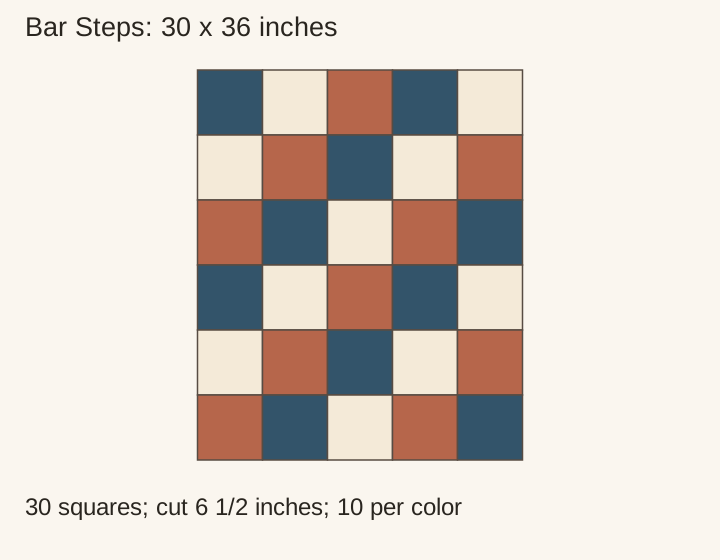
Join row one and check it before sewing the rest. It should measure 30 1/2 by 6 1/2 inches. Five 6 1/2-inch squares start at 32 1/2 inches in total; four joins use 2 inches, leaving 30 1/2 inches.
Label each row at its left end. Join the six rows in order. The assembled top should measure 30 1/2 by 36 1/2 inches, including the 1/4-inch seam allowance along each outside edge. If it does not, inspect cuts and seams while the project is still easy to spread out.
Save and print a quilt PDF without losing a page
Use the file's download control and give it a name you will recognize. Open the saved copy rather than relying on a browser tab that may close. Check the first and last pages, and scroll through the middle for any blank or cut-off diagrams.
Print a single page first. Make sure the cutting table and row labels are readable. For this written-size plan, page scaling affects the picture size but not the numbers you cut by. Measure each cut with a ruler; the printed diagram shows color order and placement.
For a pattern with full-size templates, use the publisher's print setting and measure its test square. If a test square marked 1 inch measures 15/16 inch, it is short by 1/16 inch. That is a 6.25 percent size loss, calculated as 1/16 divided by 1. A small print size error repeats along every template edge.
Other places to look for beginner PDF patterns
The Missouri Star beginner PDF guide links to beginner projects and groups them by fabric format. Follow its current links to the chosen pattern and read any access terms there. Keep that pattern's own measurements together.
Browse more projects on the National Quilters Circle free-pattern page. Check how to download a pattern and whether you need to sign up before gathering fabric for it. Our free quilt patterns guide compares other publisher libraries.
Keep a clean working copy beside the machine
Mark a tally next to each finished row. Write your fabric names beside the color letters, especially when your fabrics differ from the colors in the pattern. Add sewing reminders to the printed copy and save a photo with the PDF so you can find them later.
If you find a confusing step in another publisher's file, go back to that publisher's page for a correction or a fuller lesson. Avoid mixing a cut chart from one pattern with a row map from another. Similar cover photos do not mean the measurements match.
Once the top is ready, choose a finishing method you can practice. The free-motion quilting guide explains how to move the layers while stitching. If you need a machine, compare beginner quilting machines and check which accessories come with each model.
Verdict
Download one complete plan, check the saved file and make its first measured row. Use the PDF as a working guide, with fabric letters and row tallies visible. Add more downloads only after this project has a clear next step.
FAQ
Is the Bar Steps PDF a full-size cutting template?
No. Cut by the written dimensions using your measuring tools. The layout is a color and assembly map.
Should I print a quilt PDF at actual size?
Follow the file instructions. Full-size templates need the stated scale and test-square check. A written cutting chart stays a measurement chart even if its page is reduced.
Can I read a pattern PDF on my phone?
Yes, but save the file and zoom in to read the full cutting table. Keep the layout available while sewing so a small screen does not hide part of a row.