
Quilting
Beginners Quilt Patterns Free: Make a Four-Patch Starter
The short answer
Start with a four-patch quilt: one square size, straight rows and a block you can check before making the batch.
Last updated October 2026
What's covered8
- Free beginner quilt patterns: pick a complete first project
- Cut the cloth for a 32-by-40-inch top
- Make one four-patch block first
- Make the batch without losing the color order
- Free quilt patterns for beginners need size checks
- Choose a free publisher project for your next quilt
- Plan the finish while the top is still small
- Verdict
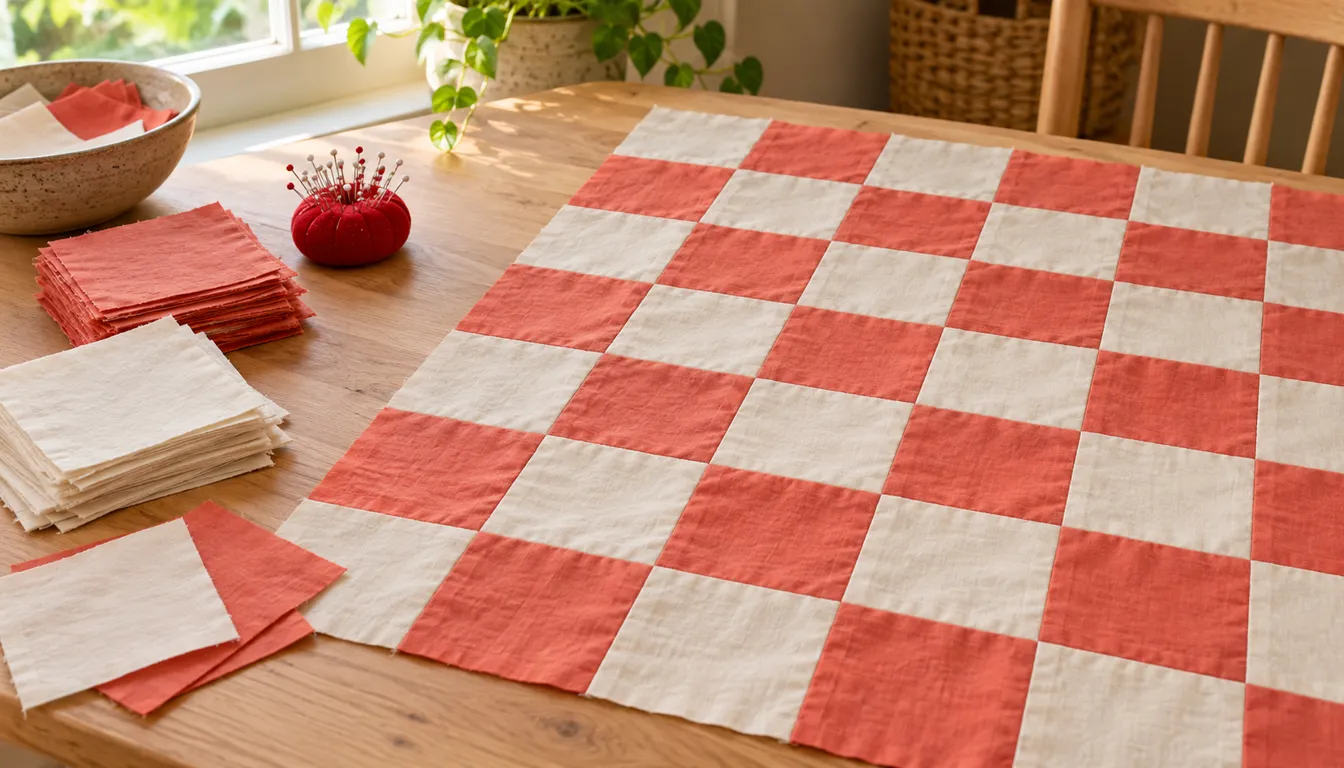
Start with a four-patch quilt if you want a free beginner project with straight seams. Each block uses four equal squares, and the whole top joins in rows. The coral-and-cream quilt below finishes at 32 by 40 inches, with measurements to check after every block.
Cut one square size, sew one sample block and check its outer size before making more. Keep the block layout beside the machine so the dark squares stay in the same corners. This starter uses 20 blocks in four columns and five rows. Plan the backing, batting and binding after measuring the completed top.
Free beginner quilt patterns: pick a complete first project
A first pattern should tell you what to cut and what to measure after sewing. A photo by itself leaves too much to guess. This project has one patch size, one block type and a straight row layout. You can stop after a sample block and still have learned the main join.
Our quilting guide explains the materials used in the top and the layers beneath it. For this top, choose two cotton fabrics with a clear light and dark difference. Coral and cream are the example colors; blue and white or green and pale gray work with the same counts.
You need 40 squares from each fabric, cut at 4 1/2 inches. Keep the two colors in separate stacks. Sew every seam at 1/4 inch. The allowances use 1/2 inch across each patch, leaving a 4-inch finished square.
Cut the cloth for a 32-by-40-inch top
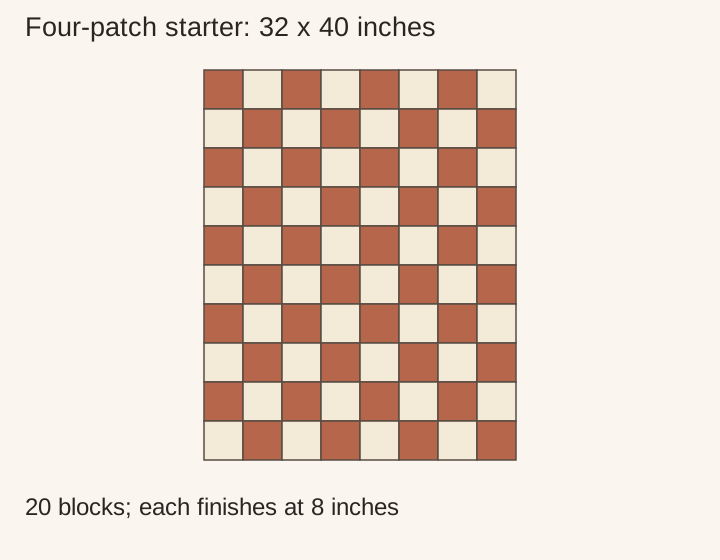
Each four-patch block has two coral and two cream squares. Twenty blocks need 20 x 4 = 80 squares. Four blocks across give 4 x 8 = 32 inches. Five blocks down give 5 x 8 = 40 inches. These are finished design dimensions before any later washing.
| Fabric | Cut size | Pieces for the top |
|---|---|---|
| Coral | 4 1/2-inch square | 40 |
| Cream | 4 1/2-inch square | 40 |
Scroll for more →
For a measured usable width of 40 inches, eight squares fit across one 4 1/2-inch strip. Eight use 36 inches, leaving 4 inches across that strip. Five strips yield the needed 40 squares in one color. They use 5 x 4 1/2 = 22 1/2 inches of length, or 22.5 / 36 = 0.625 yard.
That is the cut-length calculation for each color. Add the extra your cloth preparation and squaring require before buying. If washing or removing a flawed edge leaves less usable width, count how many squares fit across it again before cutting strips.
Make one four-patch block first
Put one coral square beside one cream square. Sew them right sides together along one edge. Make a second pair in the same way. Each pair should measure 8 1/2 by 4 1/2 inches: two 4 1/2-inch squares minus the 1/2 inch used by their shared join.
Lay the first pair with coral on the left and cream on the right. Place the second pair below it with cream on the left and coral on the right. Match the middle seams, then join the pairs along their long edges. Keep the outside edges even as you sew.
The block should measure 8 1/2 inches square before it goes into the top. If it is short, check the cut squares and seam width. Remake a poor sample before repeating it. A block that is already too small will not gain width when more seams are added.
Make the batch without losing the color order
After the sample passes, make the remaining 19 blocks. Keep a completed block in view as a color map. Each block uses two pairs, so the whole top needs 40 sewn pairs. The first sample already used two of them.
You can sew several pairs in a session, then check them before making the next group. Count completed pairs rather than guessing from the height of a stack. Keep loose squares away from finished units so they do not get counted twice.
Lay all 20 blocks out before joining. With coral at the upper left of every block, the small squares form a continuous checkerboard. A turned block will interrupt it. A photo from above makes that rotation easier to spot than a pile of blocks does.
Free quilt patterns for beginners need size checks
Join four blocks into row one. The unfinished row width is 4 x 8.5 - 3 x 0.5 = 32.5 inches. Its height remains 8 1/2 inches. Check both ends and the middle on a flat table before moving on to the next row.
Make four more rows and join them in order. The unfinished top should measure 32 1/2 by 40 1/2 inches. Those measurements include a 1/4-inch seam allowance along each outside edge, leaving a finished design of 32 by 40 inches.
If one row is longer, find the cause before joining it. Measure the blocks and count the joins. A single incorrect block is easier to fix than a full wavy top. Do not stretch the shorter row to reach the longer one.
Choose a free publisher project for your next quilt
The AccuQuilt free-pattern library offers projects to browse. Read each project's tool needs before choosing it, since a cutting system can be part of the instructions. The word free describes the pattern access, not the whole supply list.
Our free quilt patterns directory compares other publisher libraries. If you want the fewest matching points next time, use simple quilt patterns. If you liked the center join, practice the next block in beginner quilt blocks.
Plan the finish while the top is still small
Lay the top flat and measure its actual width and height. Use those figures when you choose the back and middle layer. Check the batting's quilting-distance directions and the requirements of the finishing method you will use.
The binding-a-quilt guide covers the edge finish as a separate task. Keep some matching offcuts for a small sample sandwich. That sample lets you check your proposed quilting before moving the full top through the machine.
Use a machine you can control at a steady pace. Compare beginner quilting machines if you are still choosing one. A first quilt asks more from repeatable seams and fabric handling than from a long menu of decorative stitches.
Verdict
Make one accurate four-patch before sewing the other 19 blocks. Keep the counts visible and check each row as you go. This free beginner quilt lets you practice cutting, matching corners and joining rows while using the same square size throughout.
FAQ
Do I need a downloaded file for this free beginner quilt?
No. The cutting list, block order and row plan are on this page. Save or print the page for your own working copy.
Can I use more than two colors?
Yes. Keep 40 light and 40 darker squares so the checkerboard still reads. Each block needs two from each group.
What if my first block is smaller than 8 1/2 inches?
Check that each starting square was 4 1/2 inches and each seam was 1/4 inch. Correct the sample before making the remaining blocks.