
Quilting
Beginner Quilt Blocks: A Three-Step Practice Ladder
The short answer
Practice bars, four-patch and nine-patch at one shared size. Check each new join before moving to the next block.
Last updated October 2026
What's covered8
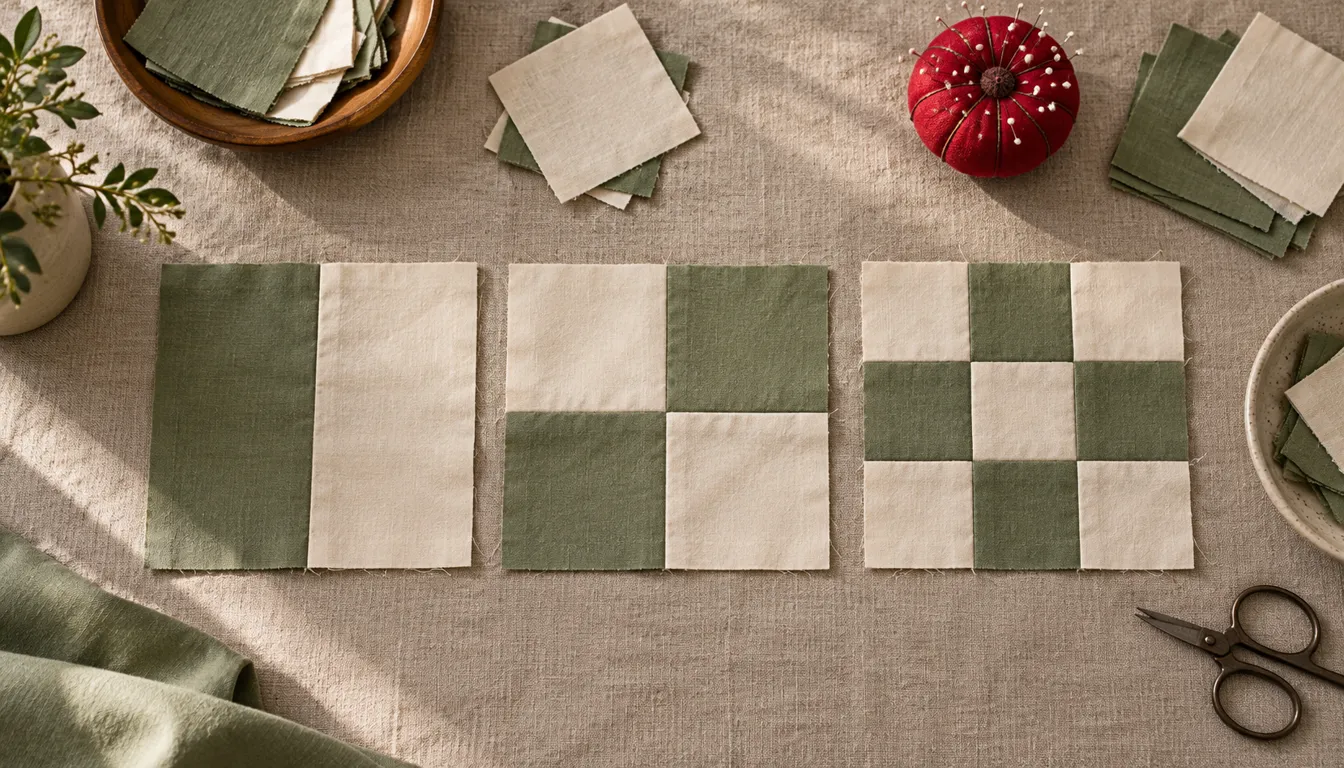
Learn to sew quilt blocks with three small samples: two bars, a four-patch and a nine-patch. Start with one seam, then practice matching seams and joining rows. Each block below finishes at 6 inches, so you can sew the samples into a single practice strip.
Use two fabrics with clear light and dark contrast. Keep one 1/4-inch seam allowance through all three blocks. Measure after every new type of join. The target unfinished block size is 6 1/2 inches square. Stop and fix a sample that misses that size before making a batch or starting a whole quilt.
Quilt blocks for beginners: learn one join at a time
The first block teaches you to keep a seam width along one edge. The second adds a center meeting point. The third adds more row joins, which makes small sizing errors easier to see. You can learn those steps with scraps that fit the required cuts.
Our quilting guide covers supplies for the later quilt layers. For these blocks, start with just the top fabrics and measuring tools. Keep a clear place to set the pieces in order. One light cloth and one darker cloth make the seam layout visible.
Use the same fabric pair through the samples if you can. That makes the comparisons easier. A new fabric, new block and new seam setup all at once give you several possible causes when the size changes.
Step one: sew a two-bar block
Cut one light and one dark rectangle at 3 1/2 by 6 1/2 inches. Place them right sides together and sew along one 6 1/2-inch edge with a 1/4-inch seam. Unfold the pair, press according to the fabric's directions and measure it flat.
The width is 3.5 + 3.5 - 0.5 = 6.5 inches, and the height stays 6 1/2 inches. This measurement includes the outer seam allowances. With 1/4-inch seams around the block, each bar finishes at 3 by 6 inches and the block at 6 inches square.
Look along the seam. Check whether the top and bottom edges line up and whether the width stays even. If the unit is narrow at one end, inspect the starting cut and seam path. Make another bar block until it reaches the target without pulling it square.
Step two: make a four-patch
Cut two light and two dark squares at 3 1/2 inches. Arrange dark-light in the top row and light-dark in the bottom row. Sew each pair. Each pair should measure 6 1/2 by 3 1/2 inches before the two rows meet.
Join the rows, matching the center seams. Check the outside for 6 1/2 inches square. Each visible patch finishes at 3 inches, so two across give 6 inches. The block has four equal patches and one center intersection.
If the center does not meet, check the two row widths first. Matching the center cannot correct a pair that was cut or sewn short. Fix the source of the difference rather than forcing the outside edges to match and hiding the error in the middle.
Step three: build a nine-patch
Cut five dark and four light squares at 2 1/2 inches. Arrange dark-light-dark in rows one and three, with light-dark-light between them. Sew each row of three squares before joining the rows.
Each sewn row should measure 6 1/2 by 2 1/2 inches. The length check is 3 x 2.5 - 2 x 0.5 = 6.5 inches. Join the rows for a 6 1/2-inch unfinished block. Each small patch finishes at 2 inches, giving 3 x 2 = 6 inches across.
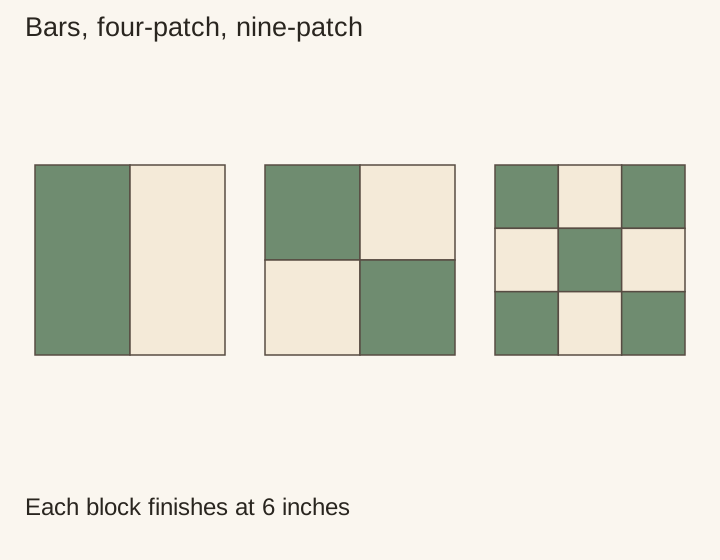
Check the last block against the first two. Its smaller pieces add more joins, so a seam-width error can show more strongly. Keep one accurate sample as your reference. Save the others for practice quilting if their construction is sound enough for that task.
Compare cutting lists for beginner quilt blocks
| Sample | Light pieces | Dark pieces | Cut size |
|---|---|---|---|
| Bars | 1 | 1 | 3 1/2 by 6 1/2 inches |
| Four-patch | 2 | 2 | 3 1/2-inch squares |
| Nine-patch | 4 | 5 | 2 1/2-inch squares |
Scroll for more →
Keep each group in a labeled tray or separate spot. The bar rectangle and four-patch square share one dimension but serve different jobs. Cutting them all into one stack makes the plan harder to check.
The three blocks use 15 fabric pieces in total: 2 + 4 + 9. That small count lets you repeat a sample without using a large amount of cloth. Choose scraps by actual usable size, leaving any damaged edge outside the cut.
Join a small practice strip
Put bars, four-patch and nine-patch in one row. Check that all three measure 6 1/2 inches high. Join their side edges with the same allowance. The finished design size is 18 by 6 inches, from three 6-inch blocks.
The sewn strip should measure 18 1/2 by 6 1/2 inches, including its outer seam allowances. Check the length: 3 x 6.5 - 2 x 0.5 = 18.5 inches. If the strip curves or pulls at a join, compare the block sizes and seam placement before quilting it.
Keep the strip to see how your sewing progresses. Write down the fabric and machine settings in a project notebook, along with a photo of the strip. Compare it with a later sample to see whether your seam widths are more even.
Move from samples to a first quilt
Choose the block that reached its size most easily. Repeat that block for the first small top instead of putting every new skill into one project. Our beginner quilt guide covers planning the whole project. The free block patterns page gives 8-inch four-patch, twin-bar and framed-square plans for a separate sampler. Those blocks are larger than the 6-inch samples here.
The Scissortail beginner block lesson is another place to browse named starter blocks. Use a complete lesson when moving to triangles or a new block family. Our quilt blocks guide explains the grid and sashing calculations.
Compare beginner quilting machines if you are choosing equipment. Work at a pace where you can watch the seam guide and hold the cloth. A correct sample is the goal before speed or a large batch.
Verdict
Use beginner quilt blocks at one shared outer size: bars, four-patch and nine-patch. Measure each new join and repeat the step that needs work. Once all three reach 6 1/2 inches without stretching, join the practice strip and choose one block for your first quilt.
FAQ
Which beginner quilt block should I sew first?
Start with a two-bar block to practice one seam. Check that both ends measure the same width, then try the four-patch to practice matching a center seam.
Do all three practice blocks use the same patch size?
No. They share the same finished outer size. Each internal layout has its own cut list to account for its joins.
Can I make a quilt from only four-patch blocks?
Yes. Choose the number of blocks across and down, multiply by the finished block size and count all patches before cutting.