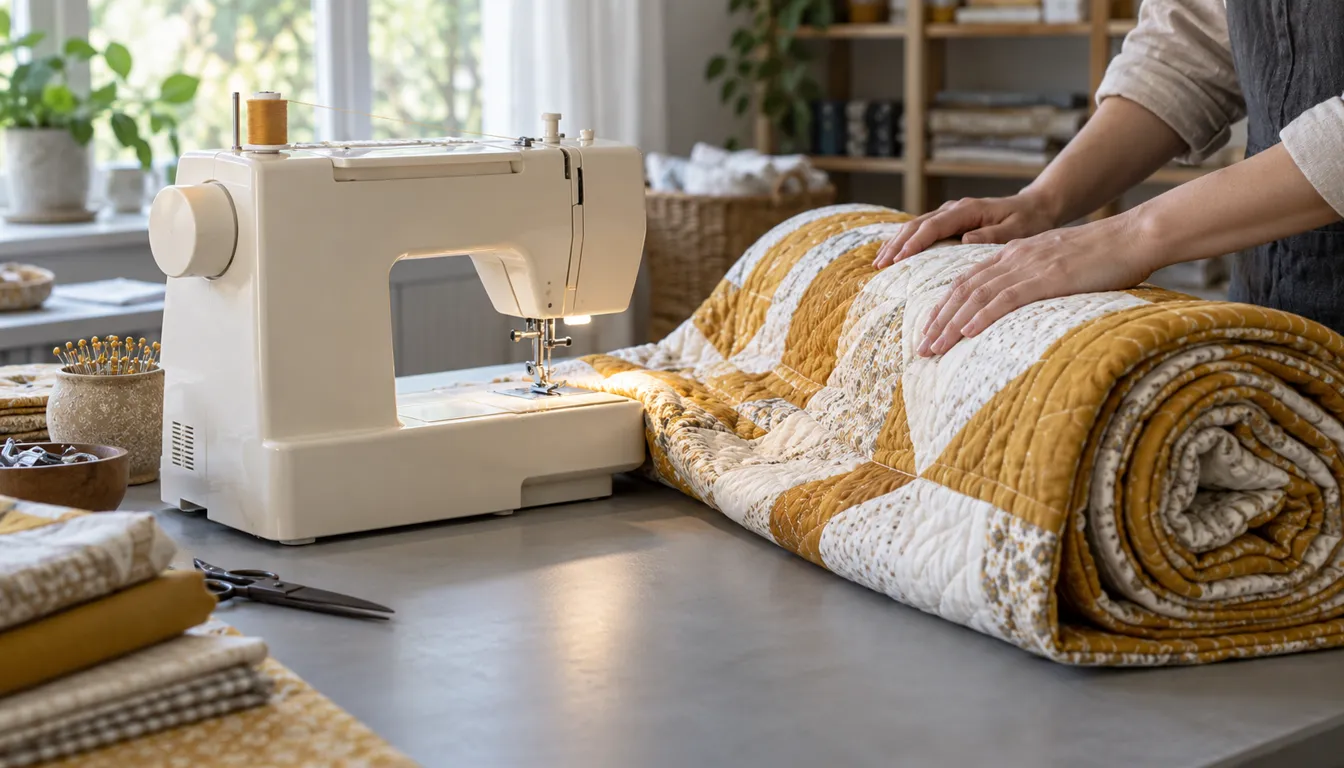
Your current sewing machine may be ready for your first quilt. Before buying another one, check whether it can join blocks, accept the right foot and stitch a small sandwich made from your quilt materials. That trial helps you tell a setup problem from a limit of the machine.
Our quilting guide explains how the top, batting and backing fit together. Use it to choose a manageable first project, then use the checks below to decide what your machine needs to do.
Sewing machine for quilting: run a two-part check
First test piecing with two pieces of your quilt fabric. Then test quilting through your chosen layers. Write down the result of each. A machine that pieces well may still feel cramped when a large sandwich is rolled beside the needle.
Find the model's manual before changing feet or plates. Record the correct bobbin, needle system and matching feet. Gather the accessories you own in one tray. It is easy to buy a second foot when the right one is already in a drawer.
Keep a short problem list. Write “the quilt falls off the left edge” instead of “the machine is bad at quilts.” The first note tells you where the quilt needs more table space. Write “I need zigzag for applique” instead of “I need more stitches.” That tells you which machine functions matter.
Test your seam with a small strip exercise
Choose a quarter-inch seam for this exercise. Cut three strips that are each 2 inches wide and 8 inches long. Sew them together along their long edges. There are two joins, and each uses 1/4 inch from both adjoining strips.
The expected width is 2 + 2 + 2 minus 1 inch, or 5 inches. The expected length remains 8 inches. The middle strip should show 1 1/2 inches between its two seams. Check those figures after pressing with the method your pattern recommends.
If the whole unit is too narrow, measure the strips you cut and the sewn seam allowance. Switch one thing before repeating the exercise. A consistent error is often easier to find with this small unit than after sewing a whole row of blocks.
Use simple quilt patterns once the test joins measure as planned. An accurate small top gives you a better starting point for quilting than a large top with uneven rows.
Test layers with the real materials
Use offcuts of the real top fabric, batting and backing. Leave enough room to move the sample without gripping close to the needle. Follow the machine manual for the technique you intend to use and sew a few lines, then inspect both sides.
Aurifil's 50wt guide suggests a needle size for that thread. SCHMETZ's needle guide explains why needle type and size are separate choices. Match them to the fabric and thread before changing tension at random.
If the sample stitches well but the real quilt feels heavy, examine the table space. If the same defect appears on the small sample, check threading, needle and the manual's settings first. Write down whether the problem happens on both pieces or only on the full quilt.
Rest the quilt before buying more arm space
Place the machine where the quilt can rest beside and behind it. Keep loose fabric from hanging over an edge. Try a stable adjoining surface at the same height if the main table is small. Make sure the setup leaves room for your hands and lets you sit close to the needle.
With the machine stopped, move the bulk into position for the next line. If you must lift the whole quilt at every turn, try arranging the bulk differently or choose a smaller first project. A wider arm gives clearance; a table carries weight.
For a step-by-step first session, see machine quilting for beginners. It starts with a sample rather than asking a new sewer to manage an entire bed quilt at once.
Match an upgrade to the remaining problem
Use the sample tests to decide what an upgrade must do. If you need zigzag or buttonholes, compare mixed-use machines. If your present machine will keep those jobs, a separate straight-stitch station may fit. If bulk crowds the needle, arrange enough table space for the quilt, then compare arm openings.
Take your written results and sample to a trial. Ask to repeat the task that was difficult at home, then check whether the new setup makes it easier.
Sewing machine for quilting: options by need
1. Brother CS7205: add mixed-use functions and table space
LCD stitch selection and automatic needle threader
Keep in mind: check the exact included feet before buying extra accessories.
Product details checked October 2026
The Brother CS7205 comes with a wide table. It may suit an upgrade from a basic starter machine without an extension table when you also need ordinary sewing stitches. Check that the new controls solve something your current machine cannot do.
2. Juki TL-2010Q: add a separate straight-stitch station
Straight stitch only, with drop feed for free-motion quilting
Automatic thread cutter and knee lifter
Adjustable presser foot pressure
Keep in mind: this is a focused straight-stitch purchase.
Product details checked October 2026
The Juki TL-2010Q is a straight-stitch machine. It can handle piecing and quilting while you keep your current machine for garment work. With two stations, you can leave one set up for straight seams and use the other for zigzag and buttonholes.
Automatic thread cutter and adjustable foot pressure
Keep in mind: the larger flatbed needs a suitable desk footprint.
Product details checked October 2026
The Janome MC6650 has a 10-inch flatbed. Compare that working area with the space on your sewing table. Put a paper outline on your desk before deciding that the larger body fits your sewing area.
Take a useful question to a trial
Bring the sample that caused trouble and ask to repeat the same task. Keep the fabric, batting and thread consistent where the demonstrator says they suit the machine. Ask how to return from the quilting setup to ordinary sewing. Try that switch yourself.
Include storage and transport in the decision. If you pack the machine away after every session, check the lifting and carrying routine. If it stays out, check that the table still has a clear cutting and prep area.
Verdict on sewing machine for quilting: buy after you name the limit
Keep your current machine when it passes the small tests and a better table setup solves the handling problem. Choose an upgrade only when its published features address the remaining gap. For a first purchase, compare beginner quilting machines; for a wider view of machine roles, read quilting sewing machines.
FAQ
Can I use a regular sewing machine for quilting?
Often, yes. Check its manual for suitable feet and settings, then begin with a small layered sample. Sewing blocks and moving a full quilt are different jobs. A sample shows whether your setup works before you commit the finished top to a larger quilting session.
Does a quilting extension table make the arm bigger?
It adds a surface around the machine bed. It does not move the machine body farther from the needle. When comparing an upgrade, ask for the workspace measurements separately from the size of the detachable table, and include the surrounding desk in your plan.
When should I replace my current machine?
Replace it when a clear, recurring limit remains after correct setup and service. That may be missing stitches needed for your other sewing, inadequate workspace, or controls that do not suit you. A single rough test with the wrong needle is weak evidence for buying another machine.