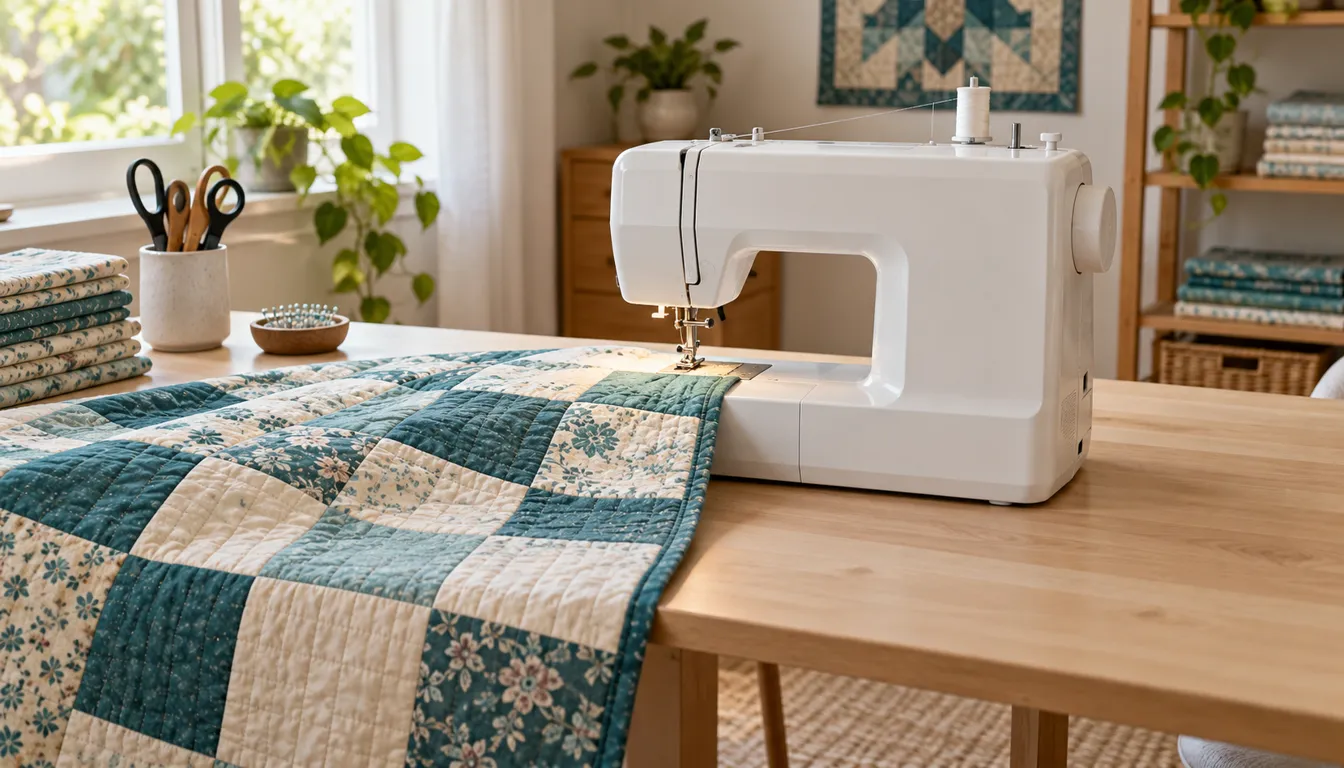
Choose a quilting machine for the work you sew most often. A mixed-use domestic machine suits blocks and clothes, a straight-stitch machine suits a dedicated piecing desk, and a larger flatbed gives you more room to handle layered quilts.
Begin with the project plan in our quilting guide. You need space to cut, press and prepare the layers as well as sew them. Set aside room for those tasks before filling the whole desk with a larger machine.
Quilting sewing machines: three useful directions
These three machines suit different sewing routines. Start with the tasks that will fill most of your time at the machine.
Brother CS7205: mixed sewing with a wide extension table.
Juki TL-2010Q: a separate desk for straight stitching.
Janome MC6650: a larger flatbed for quilts and other sewing.
You can narrow the choice before looking at decorative stitches. Ask whether this will be your only machine. Then decide whether the main problem is controlling the stitch, supporting the fabric, or fitting the rolled quilt under the arm. Those are different reasons to buy.
Match the machine to your sewing routine
For a shared desk, compare the stitches you need for quilts and clothes. For a second station, decide which tasks will stay on your first machine. When more room is the goal, measure both the arm opening and the table.
Keep those needs on your shopping sheet so that extra decorative stitches do not distract from the reason for the purchase.
LCD stitch selection and automatic needle threader
Keep in mind: the extension table does not increase needle-to-arm space.
Product details checked October 2026
The Brother CS7205 comes with a wide table, needle threader and accessory feet. Its varied sewing functions let you work on patchwork and return to ordinary sewing, while the table carries fabric around the machine bed. You can do both jobs without keeping a separate straight-stitch machine.
Think about the projects that will share the table. If you make quilt blocks in the morning and mend clothes later, stitch choice matters. If you only want to join strips, the broader menu may add little. Read the accessory list for the real carton before treating a retailer's bundle as the standard machine.
2. Juki TL-2010Q for a dedicated straight-stitch task
Straight stitch only, with drop feed for free-motion quilting
Automatic thread cutter and knee lifter
Adjustable presser foot pressure
Keep in mind: zigzag and buttonholes need another machine.
Product details checked October 2026
The Juki TL-2010Q spec describes a single-needle straight-stitch machine with speed control and an automatic thread trimmer. That focused stitch system makes sense when another machine already covers your other sewing needs.
Put its job in writing before buying: blocks, quilt sandwiches and straight seams. With a knee lifter, you can raise the foot while keeping your hands on the fabric. An automatic cutter trims thread between seams. If applique with a zigzag edge is central to your plans, keep that separate requirement on the list.
Automatic thread cutter and adjustable foot pressure
Keep in mind: its desk must carry fabric beyond the machine bed.
Product details checked October 2026
The Janome MC6650 has a 10-inch flatbed and 170 built-in stitches. The flatbed suits work that spends time spread out around the needle. Measure the table that will hold it and the space behind your chair.
A larger workspace has a clear purpose when bulk keeps crowding the arm. It will not fix a quilt dragging off the edge of the desk. Arrange the table first, then judge whether the remaining restriction comes from the machine itself. Our large-throat machine comparison goes more fully into that purchase.
Separate piecing controls from quilting controls
Piecing joins the top. Quilting stitches through the top, batting and backing. A machine can do both, but the fabric handling changes. For piecing, test whether you can keep an even seam and see the fabric edge.
For layered work, rest the whole quilt sandwich on the table. Check whether you can guide it without struggling with its weight or bulk.
Use the maker's manual for the foot, needle plate and feed settings. A foot that fits one machine may not fit another. A wide table is a table accessory. A walking foot is a feeding accessory. Neither label tells you the size of the opening beneath the arm.
List the controls you will use during an ordinary session. Needle positioning helps with stops and turns. A speed limit lets you set a comfortable pace. Foot pressure is a separate adjustment from thread tension. Give a feature priority only when you can name the task it serves.
A simple block test with real measurements
Use a quarter-inch seam for this test. Cut two sample rectangles, each 3 by 6 inches. Join their 6-inch edges. The joined width should be 3 + 3 minus two seam allowances of 1/4 inch, or 5 1/2 inches. The length stays 6 inches.
Measure the sewn sample rather than only the guide on the foot. If it is narrow, check the cutting and the seam before blaming the motor. Repeat the same join with your usual fabric. This gives you a concrete test to take to a dealer and a fair way to compare setups.
For the second test, use a small sandwich made with the batting and backing you intend to buy. Ask the dealer to show the correct setup for quilting layers. Judge how well you can see the needle and move the sample at a calm pace. Maximum speed does not answer that question.
Plan the desk and the rest of the kit
Make a floor plan of the sewing area. Mark the machine footprint, the space for the quilt to the left, and a clear area behind the needle. Include a place to set the iron safely away from loose fabric. Try that layout with your current equipment before ordering a bigger table or machine.
Verdict on quilting sewing machines: buy for the repeated task
Choose the CS7205 for varied household sewing, the TL-2010Q for a separate straight-stitch station, or the MC6650 when a larger flatbed solves a clear space problem. Bring sample fabric and a written project list to the trial. Leave with a setup you understand, including the feet and table it needs.
FAQ
How do I choose the best quilting sewing machine?
Start with the work you repeat: piecing, quilting layers, or sewing clothes. Compare table space, needle control and matching feet. Try your own fabric sandwich before deciding. A larger screen or stitch library only helps when it solves a job you actually plan to do.
What is the best sewing machine for quilting large projects?
Look at needle-to-arm clearance and the space around the machine together. A wider arm creates more room for the rolled quilt, but you still move its weight. For bed quilts, compare a larger domestic machine with renting longarm time before choosing a permanent setup.
Can a sewing and quilting machine handle clothes too?
A domestic model with zigzag, utility stitches and buttonholes can serve both jobs. A straight-stitch-only model has a narrower job. Check the exact stitch system rather than relying on the word quilting in the name, then check which feet come with that package.