Quilting Tools: Fit the Cutter, Mat and Ruler to Your Desk
As an Amazon Associate, this website earns from qualifying purchases.
The short answer
Start with a mat that lies flat on the table, a ruler long enough for your cuts and a cutter you can handle comfortably. Check the first pieces before cutting more.
Quilting tools work as a set: the mat supports the fabric, the ruler guides the measurement and the cutter follows its edge. Choose them around your desk and the longest cut in your first project. A large tool collection is less useful than a cutting station you can use comfortably.
The quilting guide helps you choose that project. For fabric, batting, thread and finishing materials, use the broader quilting supplies list. This page concentrates on reusable tools and the way they fit together.
Quilting tools: measure the work area first
Clear the table and measure the space available for a cutting mat. Allow room for the full cutting path and for your other hand to hold the ruler. Check whether the tools can stay there or must be packed away after each session.
Choose the mat before buying a long ruler. The full cutting path must stay on the mat, with the table beneath it. If the ruler extends beyond that area, move to a larger work surface for long cuts. A small mat can still serve for small squares.
Match the tool sizes to both your fabric and your table. A compact station may work well for small scraps. For long cuts from yardage, leave room to hold and align the fabric without stretching it or letting it drag over the table edge.
Build the cutting station around your desk
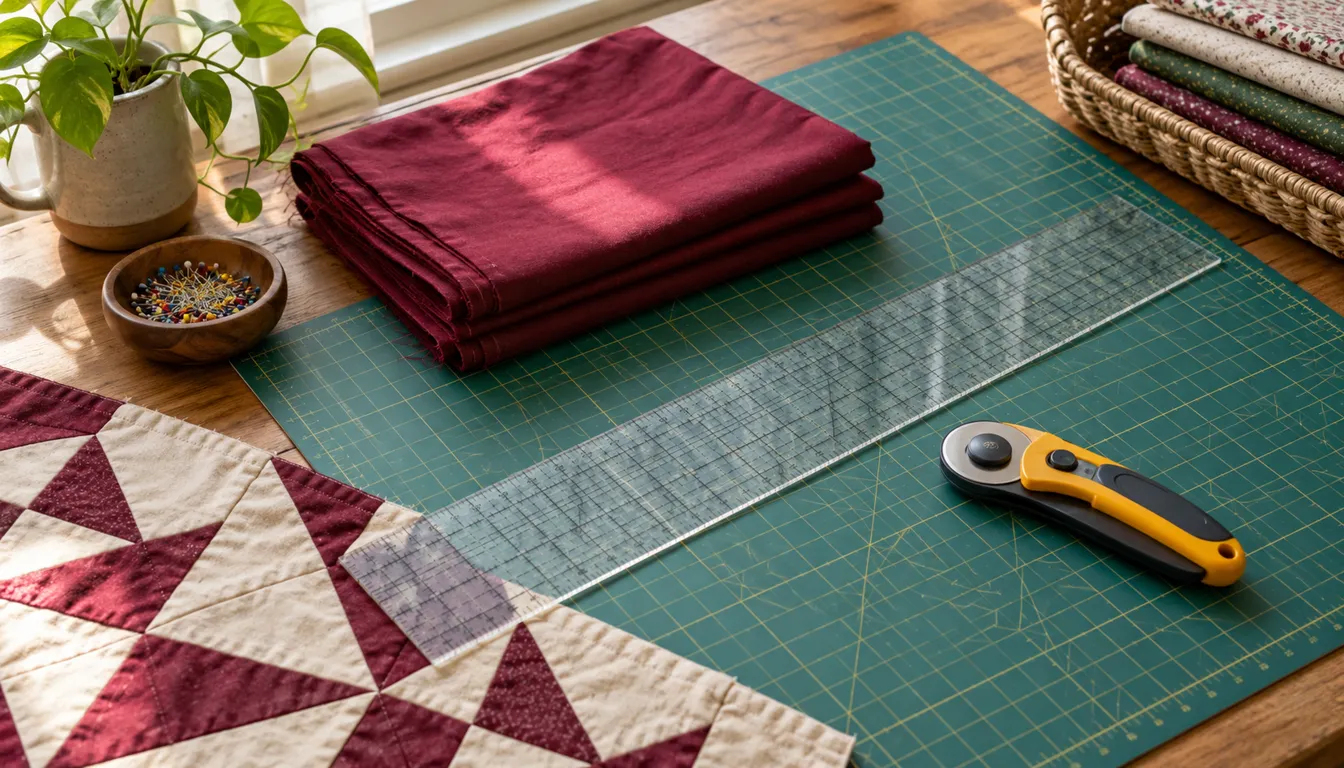
A modest mat can fit smaller pieces, while a long ruler needs enough table space for the full cut. A matched cutter-and-ruler system has a guide to learn as well as measurements to read. Try the handling steps and check the space they need before choosing one.
The products below cover a mat, a separate long ruler and a cutter-and-ruler combo. Check what you already have before buying; you may need only one part to complete your cutting station.
Keep in mind: check that your planned strip cuts fit the working area.
Product details checked October 2026
This Fiskars double-sided cutting mat measures 18 by 24 inches. Mark those four corners on your desk with removable tape to check the fit. Leave room beside the mat for fabric and the closed cutter.
A mat should lie fully supported during use. Give it a storage place that follows its care directions. Keep the iron and hot pressing work in their own area rather than assuming a cutting surface also serves as a pressing board.
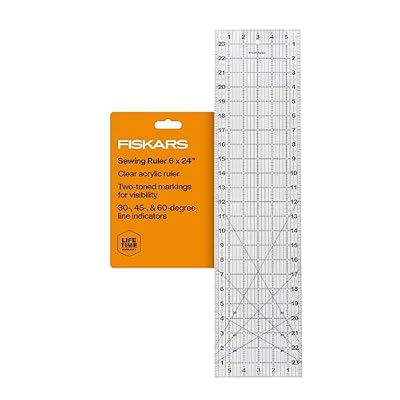
2. Fiskars 6-by-24-inch ruler for longer straight cuts
Keep in mind: a long ruler still needs stable space along the cut.
Product details checked October 2026
The clear Fiskars acrylic sewing and quilting ruler measures 6 by 24 inches and has gridlines. Its long edge has a clear job when you need straight strip cuts. Check that the line markings are easy to read against your own dark and light fabrics.
Practice aligning the fabric edge with a marked line before using the cutter. Look down at the measurement rather than from an angle. Our quilt ruler guide explains the difference between a cutting ruler and a machine-quilting template.
Keep in mind: read the system instructions instead of treating it as a generic ruler.
Product details checked October 2026
The TrueCut combo pairs a 45 mm cutter with a 6.5-by-24.5-inch ruler, track and guide, plus grips. The cutter and ruler are designed to work together. Learn how the guide works and check whether you can hold and move the tools comfortably with your cutting hand.
Try the movement before buying if a trial is available. A special guide can be useful only when you understand its setup. Keep the instructions with the tool so that a long break between projects does not leave you guessing how its parts fit.
Calculate a cut before moving the ruler
Suppose a strip must finish at 2 inches between two seams. For quarter-inch seam allowances on both sides, cut it at 2 + 1/4 + 1/4, or 2 1/2 inches wide. Find that line on the ruler before uncovering the blade.
If the measured usable fabric width is 40 inches and you need 6 1/2-inch squares, you can cut six squares across a strip: six times 6 1/2 is 39 inches. The remaining inch is not enough for another square. This is why accurate cut sizes matter when checking yardage.
Write the cut width on the project sheet. Keep “finished” and “cut” in separate columns if the pattern uses both. A ruler measures the number you select; it cannot tell whether you selected the wrong stage of the measurement.
Use a repeatable safe cutting routine
OLFA's safe cutting guidance calls for cutting away from yourself and closing the blade when a cut is complete. Before cutting, clear the mat of pins and obstacles. Keep your fingers clear of the ruler's cutting edge and the blade path.
Set down the closed cutter before moving fabric. Keep the next piece outside the blade path. Follow the maker's instructions when changing a worn blade, and use the storage method it specifies for sharp parts.
If the ruler moves during the cut, stop and reset the fabric and mat. Do not rush to finish a shifting cut. Inspect the resulting piece before adding it to the pile, because one narrow strip can affect every unit cut from it.
Add a tool only when a repeated task earns it
A square ruler can simplify trimming blocks to the same size. A specialty template may save measuring when you cut the same unit many times. Read the cutting directions first; the ruler you already have may handle the task.
For quilts using scraps, choose tools around the pieces you actually keep. A box of tiny offcuts may need a different process from cutting yardage. Sort pieces by the cut sizes in your pattern before buying another template.
Machine accessories belong to a separate fit check. Our beginner quilting machine guide explains the sewing setup. Keep model-specific feet with the machine and general cutting tools with the cutting station.
Verdict on quilting tools: build a station that fits the cut
Choose quilting tools that fit the work and the desk.
Keep the entire mat flat on the table, check that the ruler covers the cuts and follow the cutter's handling instructions. Use one small project to try the setup. Add a new tool when it solves a recurring difficulty in that work.
FAQ
Which quilting tools are basic for straight patchwork?
Use the cutting method specified by your pattern. A rotary setup needs a suitable mat, ruler and cutter that work together. Add ordinary sewing tools for the seams. Check the longest cut and your table space before choosing the tool sizes.
Does a larger cutting mat help with every project?
A larger mat gives you more cutting room, provided it lies fully on the table. It also needs more storage space. Measure the pieces you expect to cut and allow room for your holding hand and the full blade path before choosing a size.
Do I need a separate ruler for every block?
No. A rectangular ruler handles many strip and square cuts. A square ruler may help when you trim many blocks to the same size. Read the pattern to see which measurements and alignment marks you need before buying another tool.