
Quilting
Quilt Blocks: Sizes, Grids and a Sampler Plan
The short answer
Plan from the finished grid, add allowances to each piece and check every block before joining rows.
Last updated October 2026
What's covered8
- Block patterns for quilting: find the grid
- Quilt blocks: finished and unfinished sizes
- Quilt block patterns at one shared size
- Quilt square patterns: plain patches can join the sampler
- Join quilt blocks with measured sashing
- Keep block problems out of the joined rows
- Browse named blocks without guessing the construction
- Verdict
Quilt blocks are the repeated units that make up many quilt tops. Each block can contain plain squares, strips or triangles, but its outer size must fit the layout. Start by learning finished and unfinished sizes, then use equal-size blocks to plan rows, sashing and borders.
A block's finished size is the part visible after it enters the quilt. With 1/4-inch seams, its unfinished outer size is 1/2 inch larger in each direction. Internal pieces need their own allowances. Build the block from its written cutting list, measure the result and join it only when it matches the planned outer size.
Block patterns for quilting: find the grid
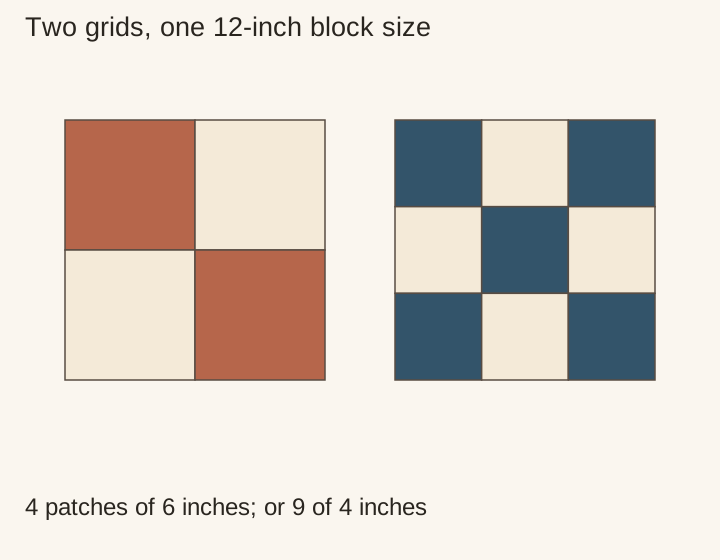
A block grid divides the finished square into equal units. A four-patch has a two-by-two grid. A nine-patch has a three-by-three grid. More detailed blocks may use one of those grids even when some units are divided into smaller pieces.
The quilting guide covers materials for the top and layers. For block planning, use paper first. Mark the finished outside square, then divide it into equal units. Label those visible sizes before adding any seam allowances.
For example, a 12-inch finished four-patch has two 6-inch units across. A 12-inch finished nine-patch has three 4-inch units across. Their cut patch sizes differ, yet both completed blocks should measure 12 1/2 inches on the table before joining.
Quilt blocks: finished and unfinished sizes
The two outer allowances account for the difference. At 1/4 inch on the left and 1/4 inch on the right, the cut or unfinished width carries 1/2 inch more than the visible width. The same applies to height.
| Finished block | Unfinished outer size | Plain square replacement |
|---|---|---|
| 6 inches | 6 1/2 inches | Cut 6 1/2 inches |
| 8 inches | 8 1/2 inches | Cut 8 1/2 inches |
| 10 inches | 10 1/2 inches | Cut 10 1/2 inches |
| 12 inches | 12 1/2 inches | Cut 12 1/2 inches |
Scroll for more →
A pieced block has seams inside it as well. You cannot divide the unfinished outside size by the grid count to get every internal cut. Work from finished unit sizes, then add the allowance to each plain patch. Triangle units use a method-specific starting size.
Quilt block patterns at one shared size
Make these two blocks at a 12-inch finished size so they fit together in a sampler. For the four-patch, cut two rust and two cream squares at 6 1/2 inches. Sew a rust-cream row and a cream-rust row. Join the rows with opposite colors touching, then check that the block measures 12 1/2 inches square.
For the nine-patch, cut five blue and four cream squares at 4 1/2 inches. Arrange blue-cream-blue in the first and third rows, with cream-blue-cream in the middle. Join the squares into rows, then join the rows. Again, the block should measure 12 1/2 inches.
The four-patch uses four patches with 6-inch visible widths. The nine-patch uses nine with 4-inch visible widths. Both cover the same final 12-inch square. Their different internal seam counts are already included in their separate cut lists.
Quilt square patterns: plain patches can join the sampler
A plain square is a useful resting area between busy blocks. To replace a 12-inch finished block, cut a plain square at 12 1/2 inches. It matches the unfinished outer size of the pieced blocks. You can use it to show a large print without more internal seams.
Make two four-patches, two nine-patches and two plain squares. You now have six blocks. Arrange them in two rows of three, changing their order in the second row. Without sashing, the finished top is 3 x 12 = 36 inches wide and 2 x 12 = 24 inches high.
The full cutting count is eight 6 1/2-inch squares for the four-patches, eighteen 4 1/2-inch squares for the nine-patches and two 12 1/2-inch plain squares. The block plans above show how many of each size to cut from each fabric.
Join quilt blocks with measured sashing
Sashing is the fabric strip between blocks. To space out the six blocks in this sampler, add sashing that finishes at 2 inches wide. Two vertical strips add 4 inches across each row, and one horizontal strip adds 2 inches between rows. The finished top becomes 40 by 26 inches.
Cut four vertical strips at 2 1/2 by 12 1/2 inches, two for each row. Assemble block-strip-block-strip-block. Each row should measure 40 1/2 by 12 1/2 inches. Cut one horizontal strip at 2 1/2 by 40 1/2 inches, then join it between the two rows.
The unfinished top should measure 40 1/2 by 26 1/2 inches. This version has no outer sashing. If you add an outside frame, calculate its widths and cut lengths as a separate step after measuring the top.
Keep block problems out of the joined rows
Measure each block after sewing. Check both directions and compare opposite edges. If one is too small, inspect its internal patches and seam widths. Stretching it to fit a larger neighbor makes the next stage harder.
Label the block with its pattern name and target unfinished size. Keep a photo of the correct layout, especially when a triangle block can rotate. A block may be the right size but still have a unit turned the wrong way.
For starter practice, use beginner quilt blocks. For three complete small plans, use free quilt block patterns. Those pages let you practice the inside joins before planning a whole sampler.
Browse named blocks without guessing the construction
Browse pictures of named designs in the Scissortail quilt block library. When you find one you like, read its instructions before cutting. Blocks with similar names or pictures may use different piecing methods.
Choose quilt fabric with the visible patch size in mind. Large motifs may suit plain blocks while smaller prints can show in the nine-patch. Compare beginner quilting machines if you need help choosing a setup for repeated seams.
Verdict
Plan from the finished grid, cut with the required allowances and check the unfinished outside size. Equal outer sizes make a sampler possible even when the blocks have different internal pieces. Add sashing only after you have counted its gaps and measured its cut lengths.
FAQ
What is the difference between a quilt block and a patch?
A patch is one fabric piece. A block is a larger unit made from patches, or sometimes a plain square, that fits into the top layout.
Can different block patterns go in one quilt?
Yes, when their unfinished outer sizes match the layout. Check each block before joining and plan sashing if it is needed.
Why is my 12-inch block 12 1/2 inches on the table?
The extra 1/2 inch supplies two outer 1/4-inch allowances. The visible block becomes 12 inches after those edges enter seams.