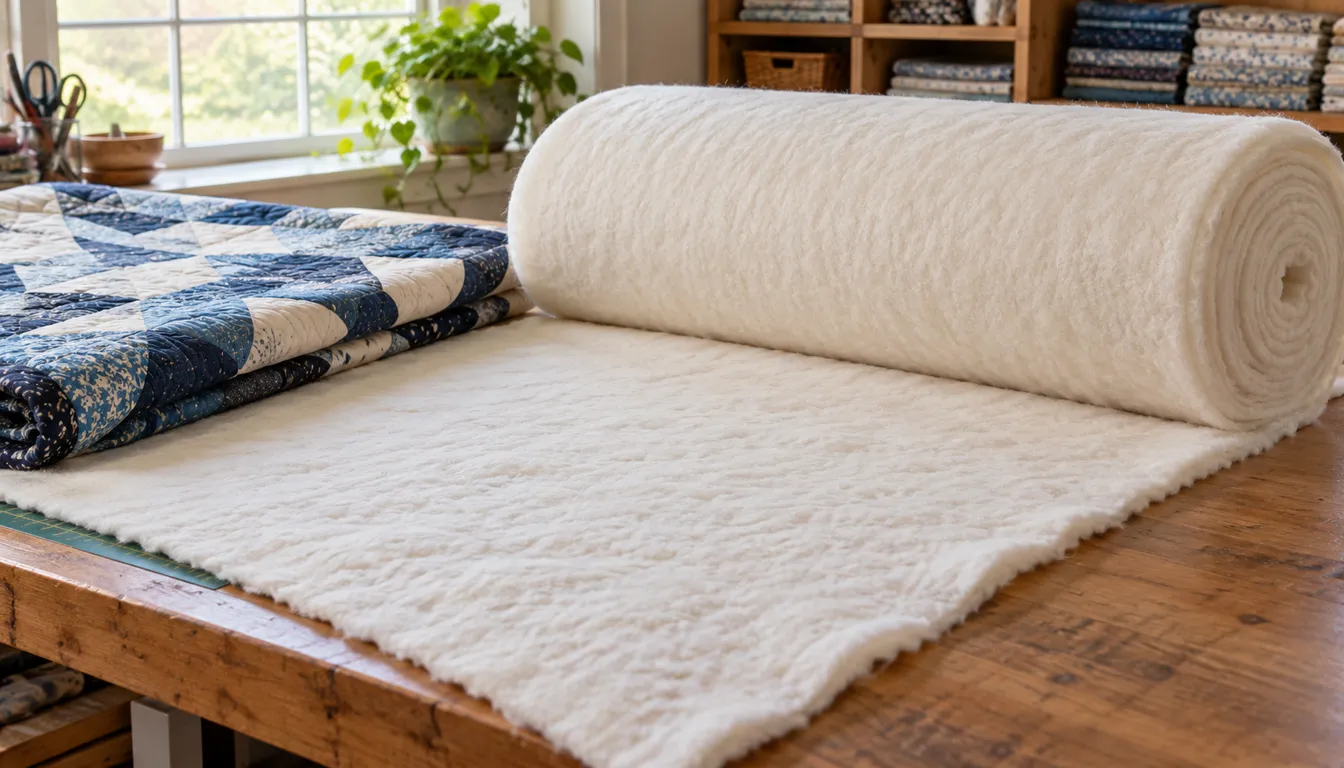
Quilt batting by the roll is useful when you expect to use the same product for several quilts. Choose the width from your usual top sizes plus quilting margins. Then calculate the number of cuts from the roll's linear length, leaving room for squaring and your real project mix.
The quilting guide helps you plan the whole project. Choose the fiber and structure with our batting guide before making a bulk purchase. Roll size is a buying format, separate from the product's suitability.
Quilt batting by the roll: read width and length separately
A roll described as 96 inches by 30 yards is 96 inches wide with 30 yards of length. Convert the length to inches before planning cuts: 30 times 36 equals 1,080 inches. That does not mean every quilt rectangle will use the full width well.
QuiltBatting.com's roll category shows why width and length need to stay attached to each product. Read the exact format before comparing two rolls with the same fiber details.
Make a list of your next few likely quilts. Include the rectangle needed after margins, not just the finished top. It is easier to judge a roll using three real projects than a guess that all future quilts will be the same size.
Compare usable cuts and storage needs
Check the fiber before comparing roll sizes. On paper, map several quilt rectangles across each roll width, with the margins your method needs. Try both orientations and count whole cuts along the length. A wider roll may produce more useful pieces or leave larger offcuts.
Plan where you will unroll and store the batting. The right quantity should fit your sewing space as well as your likely projects.
Keep in mind: check the full cut plan before choosing a 30-yard supply.
Product details checked October 2026
This Heirloom 80/20 cotton-polyester blend roll is 96 inches wide and 30 yards long. Hobbs' product guidance explains the quilting and care requirements for that batting.
Choose the product because you like its quilted result, then check whether the roll fits your cut plan. Label each offcut with the batting name and measurements. Keep the product instructions so you can check stitch spacing and care when using a leftover piece.
Keep in mind: the product choice and the width need separate checks.
Product details checked October 2026
The Soft & Bright polyester batting roll is 90 inches wide and 25 yards long. That length converts to 25 times 36, or 900 inches. Use those sizes to compare a real set of needed rectangles.
A shorter roll can still be a large commitment if you finish only a few quilts. Check where the roll will rest during cutting and where it will stay between projects. Choose storage before delivery so the material does not become an obstacle in the sewing room.
80 percent cotton and 20 percent polyester, without scrim
120-inch width with 10 yards of length
Keep in mind: a wide offcut only helps if a later project can use it.
Product details checked October 2026
This Nature’s Touch natural cotton-polyester blend has no scrim and comes in a 120-inch-wide, 10-yard roll. Its length is 360 inches. Compare the complete format with narrower rolls rather than treating width as the only measure of quantity.
A wide roll can cover a large top in one piece, while smaller tops may leave a long strip beside each cut. Map both layouts to see which fits your work. Keep the maker's complete product instructions with the roll and any pieces cut from it.
Calculate a repeated cut yield
Suppose you need batting rectangles of 68 by 80 inches. On a 96-inch-wide roll, place the 68-inch side across the width and cut an 80-inch length. From 1,080 inches, thirteen such cuts use 1,040 inches and leave 40 inches in length.
That is a theoretical yield before squaring and other allowances. It also leaves a 28-inch-wide strip beside each 68-inch cut. Thirteen cuts produce thirteen such strips, which are useful only if their sizes fit another planned project.
Turn the rectangle to compare. Put the 80-inch side across the roll and cut lengths of 68 inches. Fifteen cuts use 1,020 inches and leave 60 inches in length, with a 16-inch side strip per cut. This orientation produces more full rectangles in the simplified plan.
Both layouts fit the same roll. The difference comes from orientation and whole-cut rounding. Add the prep allowance you need, then recalculate rather than assuming the theoretical maximum is a guaranteed project count.
Plan smaller rectangles across the width
For smaller projects, suppose you need rectangles of 44 by 54 inches. Two 44-inch widths fit side by side on a 96-inch-wide roll: 2 times 44 equals 88 inches. That leaves 8 inches across the width.
Each 54-inch length therefore gives two rectangles. Ten such lengths use 540 inches, or 15 yards, and give twenty rectangles in this simplified layout. That setup may suit repeat small projects better than cutting one rectangle across the full width each time.
The calculation uses chosen sizes for illustration. Replace them with your real top and margin. Use quilt blocks to plan a top, then measure its sewn result before assigning a final batting cut.
Keep a cut ledger with the roll
Write the starting width and length, then record each cut and its date in your project notebook. List the offcut sizes too. When a new project starts, check that ledger before unrolling fresh batting.
Label each offcut with the product name. Keep pieces clean and store them according to the maker's directions. If you plan to join offcuts, follow the batting maker's joining instructions and check that the method suits your project.
For a first sewing setup, compare beginner quilting machines and make a sample with the selected batting. A bulk purchase should follow that useful test.
Verdict on quilt batting by the roll: buy the width your cut plan can use
Buy quilt batting by the roll after the cut plan shows a repeated need.
Choose a batting you have tried, map several real rectangles and compare both orientations. Convert yards to inches and round down to whole cuts. Keep an allowance for prep and a plan for storage. The right roll is the one that fits your repeated projects and your room.
FAQ
How many quilts can I cut from quilt batting by the roll?
Divide the roll’s length in inches by the needed cut length, then round down to whole cuts. Check the roll width separately to make sure each rectangle fits. Allow for squaring and compare layouts for the quilt sizes you expect to finish. Offcuts may also fit smaller projects.
Is a wider batting roll always a better purchase?
Choose a width that fits your usual quilt rectangles, including margins. Map a few cutting layouts on paper to see how much batting remains beside each cut. Check whether you can use those offcuts, and measure the space where you will handle and store the roll.
Can I buy a roll before choosing the batting fiber?
Try a smaller sample of the exact product first when possible. Quilt and wash it according to its instructions, then decide whether you want that same structure for several projects. A large quantity is most useful after the product has a clear repeated job.