
Quilting
Long Arm Quilting Machine: A Room and Workflow Buying Guide
The short answer
Buy after a trial of the movement, loading and controls. Confirm the installed footprint, delivery, training and service before making room for a frame.
Last updated October 2026
What's covered8
- Decide what you want to quilt
- Frame-mounted and sit-down systems require different skills
- Measure the installed footprint
- Separate stitch regulation from automation
- Computerized long arm quilting machine: inspect the whole process
- Test with a quilt sandwich you understand
- Compare ownership with lessons or a finishing service
- Verdict on long arm quilting machine: buy the full setup you have tried
A longarm can suit you if you want to quilt your own tops and have room for a dedicated finishing system. Try moving the machine over a sample quilt. Compare the head, frame and controls together. Include lessons, delivery and service in the buying decision. Stitching is only part of the work.
The quilting guide covers the project from material choice onward. If you want a longarm finish without owning a frame, our longarm service prep guide explains the handoff instead.
Decide what you want to quilt
Write down the quilt sizes you expect to finish and how often you finish tops. Include the designs you want to sew: simple all-over lines, freehand curves or detailed work in individual blocks. Ask to try those designs during the demonstration so you can judge the tasks you will repeat at home.
Baby Lock's longarm range and BERNINA's longarm category show specialist systems worth investigating with a dealer. Use the exact product documents for measurements and fit. A category photograph cannot prove which frame or controls come with a particular purchase.
Ask whether the quoted setup includes the frame, table or cabinet shown. Then ask about delivery, assembly, instruction and service. Keep those answers on one sheet so that two packages can be compared on the same basis.
Frame-mounted and sit-down systems require different skills
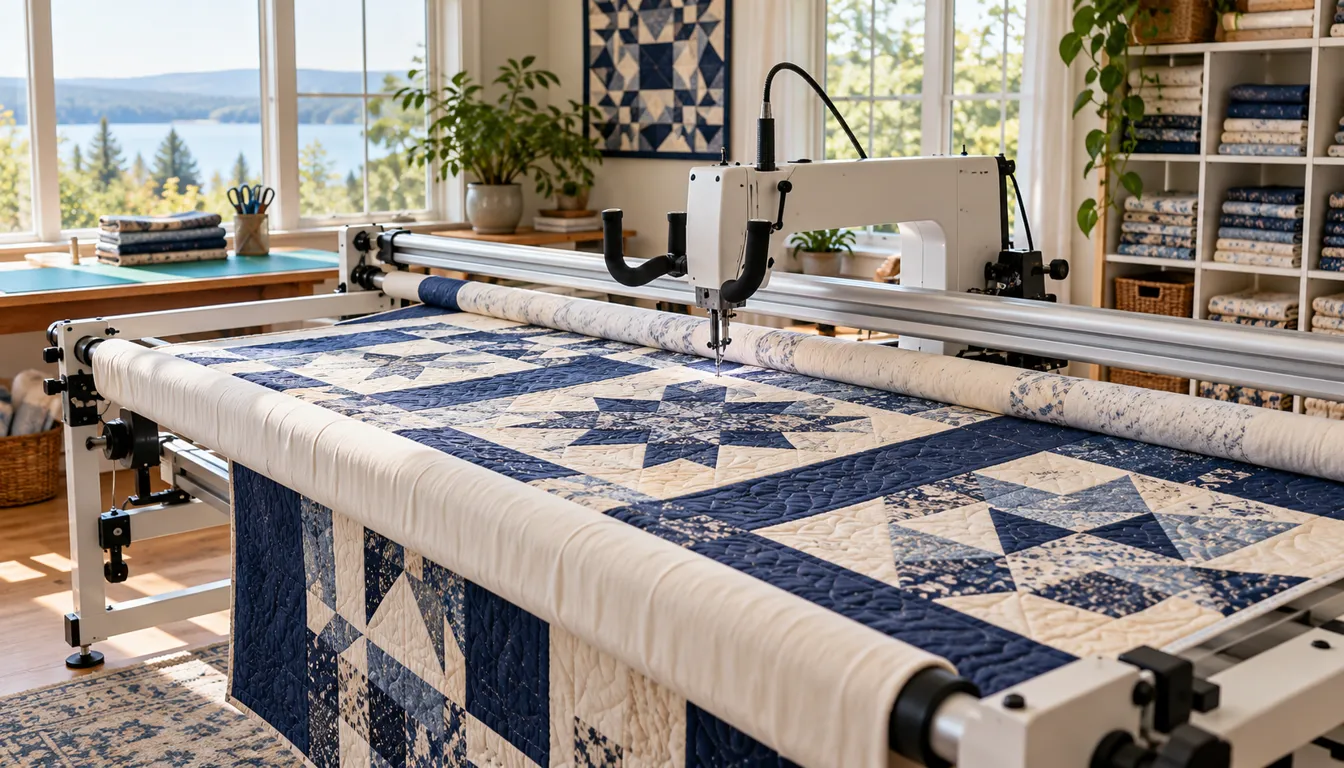
With a frame-mounted machine, the layers are loaded and you move the machine head over the working area. With a sit-down setup, you generally move the quilt under the needle. Try both if your goal is easier fabric handling.
For a frame trial, ask to move the head toward you, away from you and through a curve. Follow a marked line and try stopping at a specific point. Watch how the rollers and side clamps affect the area you can reach. Ask to see what happens as the finished section rolls up.
For a sit-down trial, put enough fabric around the sample to feel its weight and drag. Try moving that bulk yourself. Pay attention to the movements you will repeat at home. An expert may make a setup look easy, so give yourself time to try it too.
Measure the installed footprint
Get the sizes for the real machine and frame combination. Ask which clearances the maker requires and which extra access the dealer recommends. Include the working position, maintenance access and a place to hold the remaining batting and backing.
Add access space to the equipment dimensions when planning the room. For example, take a setup 12 feet long and 4 feet wide. With 2 feet of access at each short end, plus 3 feet at the front and 2 feet behind, the clear rectangle is 16 by 9 feet.
The area is 16 times 9, or 144 square feet. For your purchase, calculate the footprint using the maker's installation plan and the access space you need. Measure door swings and walking routes inside that rectangle too.
Check delivery before assembly day. Stairs, corners and doors can matter even when the finished frame fits. Ask which parts arrive assembled, who carries them inside and what surface the frame needs to stand on.
Separate stitch regulation from automation
Ask the dealer to explain the exact modes on the proposed machine. A stitch-regulation feature and a system that follows a design solve different tasks. Request a plain trial of each mode you are comparing.
For regulation, follow a simple curve at different speeds. Pause to see how the mode handles a stop. For automation, ask how you place the design, set boundaries and check that it fits the current quilting area.
Write down which features come with the machine head and which need an added system. Ask what hardware, software and frame an upgrade requires. Get the compatible combination in writing rather than planning around a general promise that automation can be added later.
Computerized long arm quilting machine: inspect the whole process
Watch a design from setup to the next advance. The useful questions start before the machine stitches: how do you mark the quilt boundary, choose the design size and check placement? Then ask how to stop, inspect and resume the work.
After the sample stitches, watch the operator advance the quilt and align the next section. Ask what prep keeps the pattern consistent across the quilt. Include thread changes, bobbin checks and the end of the project in the trial.
Make sure the dealer explains training and help for the automation system itself. Being able to sew a freehand line does not teach design placement software. Set aside learning time for both skills before planning a long list of finished quilts.
Test with a quilt sandwich you understand
Bring fabric and batting that represent your own projects, subject to the dealer's sample rules. Try a plain line and a curve before a detailed design. Look at both sides of the result and ask which settings were used.
The SCHMETZ needle guide explains that longarm machines may require a different needle system. Find the exact needle and bobbin specifications in the manual before buying spares. Similar-looking parts from a domestic machine may not fit.
Read the stitch-spacing instructions for the batting you will use. Hobbs gives a maximum spacing for Heirloom 80/20. Check that the design fits within that limit, including open areas between motifs and near the borders.
Compare ownership with lessons or a finishing service
List the tasks you want to do yourself and the time you can give them. Include loading and maintenance alongside stitching. A class or rental session gives you practical evidence before the frame becomes a permanent room fixture.
If you mainly enjoy piecing, a finishing service can keep your project moving while you learn at your own pace. If you enjoy the quilting itself, repeat rental sessions can help you judge the equipment features you use most.
For smaller projects and ordinary sewing, compare beginner quilting machines and the large-throat domestic guide. Those guides cover domestic sewing setups for piecing and smaller quilts.
Verdict on long arm quilting machine: buy the full setup you have tried
Choose a longarm after you have tested the movement, seen the loading process and measured the installed system. Confirm training, service and matching consumables. A clear plan for the room and the work gives the purchase a stronger basis than a list of maximum features.
FAQ
What does a computerized long arm quilting machine do?
An automation system can guide the machine through a selected design. The operator still prepares the quilt, loads the layers and checks the stitched result. Ask for a complete trial that includes design placement and advancing the quilt, rather than only watching a design run on a sample.
Is a long arm sewing machine suitable for ordinary sewing?
That phrase can describe different equipment. For quilting, check whether the head moves on a frame or stays at a table. A frame quilting setup is a finishing system, so plan to keep a domestic machine for piecing and other household sewing.
How much room does a longarm need?
Use the installation plan for the exact frame and machine. Include operator access, the route behind the frame, storage and delivery. Frame length alone does not tell you how much space the setup needs. Mark the whole needed footprint on the floor and confirm the room before placing an order.