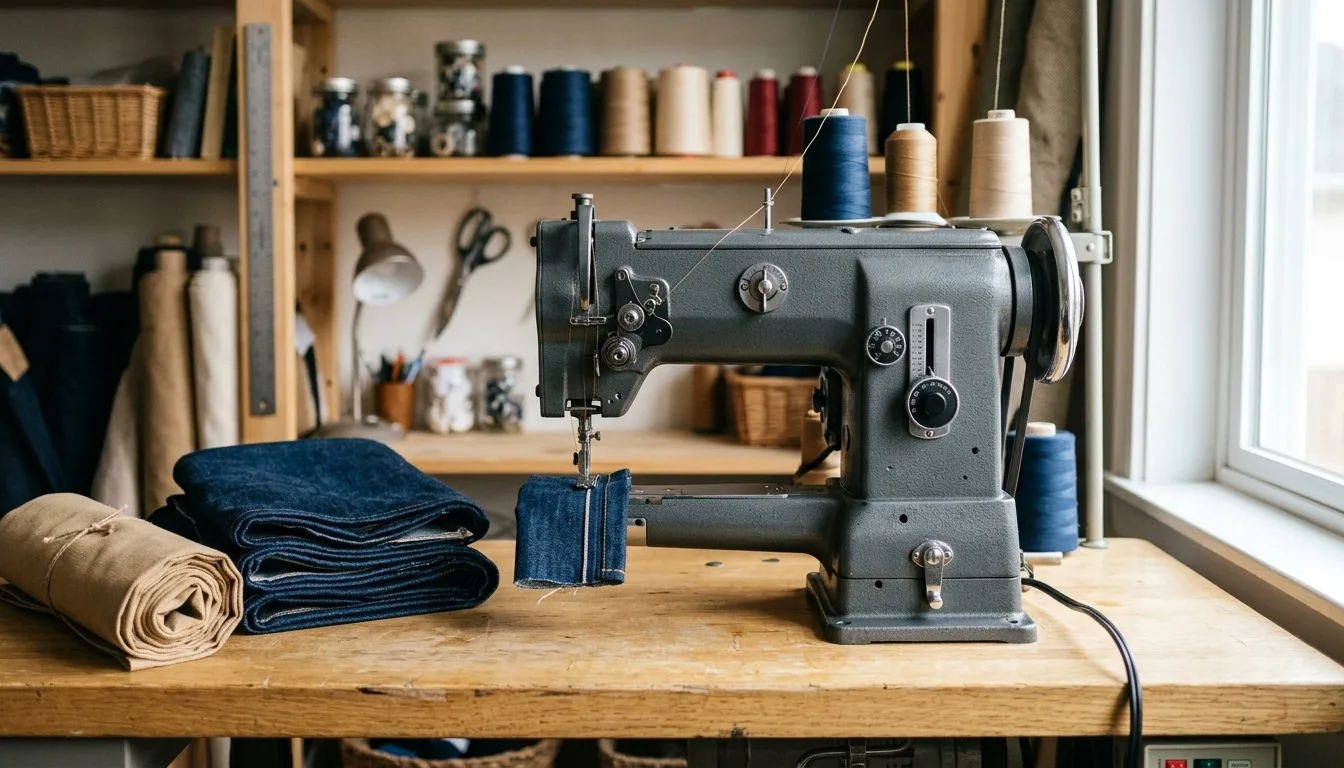
6 Best Heavy Duty Sewing Machines for Denim, Canvas and Bags in 2026
As an Amazon Associate, this website earns from qualifying purchases.
The short answer
Start with the SINGER 4423 for simple controls, the Janome HD3000 for adjustable foot pressure, or the Brother ST150HDH for screen-based stitch selection. All six picks are domestic machines with material limits.
A sewing machine for heavy duty work has to push a needle through thick layers again and again. It must not stall or skip. It must not shift either. Denim hems, canvas tote bags, upholstery and outdoor gear all ask more of a machine than quilting cotton does. This guide compares six current domestic machines by their makers' listed features.
Then it explains which features help with heavy fabric and which claims to read with care. We have not tested these machines. The comparison uses published specs.
#1. SINGER Heavy Duty 4423 Meltwater Blue: first heavy-duty machine
Linked offer is the Meltwater Blue version with accessories
Keep in mind: the pedal needs practice when crossing a thick seam slowly.
Product details checked October 2026
The 4423 is the straightforward starting point here for a domestic machine with basic, stretch and decorative stitches. SINGER lists 23 built-in stitches, a one-step buttonhole, an automatic needle threader and a metal frame. The linked listing is the Meltwater Blue machine with accessories.
Its advertised top speed is not a promise that it can sew any stack of denim. Use a suitable needle, support the fabric and slow down where seams cross. Our SINGER Heavy Duty 4423 guide covers the model's controls and setup. Choose it for ordinary home garments and bags within its limits, rather than continuous commercial sewing.
#2. SINGER Heavy Duty 4452 Holiday Bundle: table and extra feet
Walking, non-stick, blind hem and open-toe feet listed
Keep in mind: the high top speed still needs careful pedal control at bulky seams.
Product details checked October 2026
This exact Holiday Bundle lists the 4452, a removable extension table and extra feet. Its catalog includes walking and non-stick feet, plus blind hem and open-toe feet. Compare that package with the accessories you would need to add to a 4423 for your projects.
The base machine adds 32 built-in stitches and a one-step buttonhole. The table supports work beside the needle; it does not increase clearance under the foot or turn the machine into an industrial model. Check which supplied foot matches the material, and sew a sample before starting a large bag or canvas panel.
Keep in mind: its dial stitch selection gives fewer decorative choices than a computerized model.
Product details checked October 2026
The HD3000 is a mechanical alternative for readers who want to adjust presser foot pressure rather than rely on one setting for every fabric. Janome lists 18 stitches, a one-step buttonhole, a built-in needle threader and a hard cover. The linked offer includes the hard case.
Pressure adjustment is a setup tool, not a guarantee that thick layers will feed cleanly. Try a scrap with the same seams and interfacing as the project, and change needle size and stitch length deliberately. Choose it when its mechanical controls and pressure adjustment matter more than a large stitch menu.
#4. Brother ST150HDH with thread: computerized controls
Keep in mind: its menus need learning and do not remove limits on seam thickness.
Product details checked October 2026
Brother lists 50 built-in stitches, five auto-size buttonholes, a drop-in bobbin and nine feet. The LCD shows stitch information, while the wider stitch choice leaves room for utility and garment work beyond straight denim seams. The linked package includes a six-pack of sewing thread.
Pick it because you will use those controls, not because more stitches imply more piercing power. Needle choice, foot choice and a trial seam remain necessary. For lighter first projects, our beginner sewing machine guide explains the trade between dial and screen controls.
Keep in mind: its four-step buttonhole requires more manual steps than the HD3000.
Product details checked October 2026
Janome lists 14 stitches, a four-step buttonhole, a needle threader and an aluminum body and internal frame. The HD1000 suits readers who prefer direct dial control and do not need the extra stitch selection of the other picks.
It uses a front-loading bobbin arrangement, which is a different setup habit from the drop-in models here. Read the manual before your first threading and practice the buttonhole on the intended garment fabric. This is a household mechanical machine; do not treat the heavy-duty name as permission to sew thick belts or stacked upholstery continuously.
#6. SINGER Heavy Duty 4432 Sterling: more dial-selected stitches
Linked offer is the Sterling edition with accessory kit
Keep in mind: the extra stitches do not establish better feeding or motor power than the 4423.
Product details checked October 2026
The 4432 Sterling offer is a named accessory package. SINGER lists 32 built-in stitches and a one-step buttonhole, compared with the 4423's 23. That is a useful difference for garments using stretch or decorative stitches, while the basic home-machine workflow remains similar.
Choose on the stitches and package you need. We have not measured penetration force or compared durability between these SINGER models. A suitable foot and needle still matter at a bulky bag seam. If you only need straight seams and a buttonhole, the 4423 above remains the simpler comparison point.
Factors to consider when choosing a heavy duty sewing machine
There is no single standard for the label, so look for the parts that do the work:
Piercing power. A stronger motor and good gearing keep the needle moving through several layers at low speed. Makers describe this in different ways. SINGER, for example, says the 4423 has a 60% stronger motor.
A metal frame. A rigid internal frame keeps the needle and hook in line under load, which helps prevent skipped stitches on thick seams.
Presser foot pressure and lift. Adjustable pressure lets you ease off for thick or spongy layers. A higher lift lets bulky work slide under the foot.
A good feed system. Strong, well-aligned feed dogs, and the option of a walking foot, stop the top layer from creeping.
Stitch length. Longer stitches look better and feed more easily on heavy fabric.
Speed. A high top speed helps long seams, but slow, steady power matters more on thick layers.
How to sew heavy fabric on a home machine
The machine is only half of it. These habits matter just as much:
Use the right needle. Pick a jeans needle for denim and canvas, and a leather needle only for real leather. Go up a size for more layers. See the sewing needle size chart.
Use stronger thread. All-purpose polyester works for many projects. Heavier upholstery or topstitching thread needs a larger needle eye.
Lengthen the stitch. A longer stitch looks better on thick fabric and puts less stress on the thread.
Slow down at thick spots. Turn the handwheel by hand over bulky seams, such as a jeans hem where several seams meet.
Level the foot. At a thick seam, a small shim (a folded scrap or a hump jumper tool) under the back of the foot keeps it level so it does not stall.
Use a walking foot for layers that shift, like quilted canvas or vinyl.
Heavy-duty claims to read carefully
"Sews anything." No home machine sews everything. Check what the maker actually recommends, and test on your real material.
Top speed. Fast speed does not equal piercing power. Slow, controlled force is what gets through a thick seam.
Leather. Soft garment leather is often possible. Thick belts and saddles, or many layers, need an industrial or leather machine.
"Metal" features. A metal frame inside matters more than a metal-look finish outside.
When a heavy-duty home machine is not enough
If you sew heavy canvas or leather most days, look at an industrial walking-foot machine, or a portable walking-foot machine made for that work. These cost more. They often need a table and a separate motor. For denim, bags or home decor now and then, a heavy-duty home machine is usually the sensible choice.
Many can handle thin, soft leather and faux leather with a leather needle, a longer stitch and a non-stick or walking foot. Thick saddle leather and many layers of leather need an industrial or dedicated leather machine.
What needle should I use for denim on a heavy-duty machine?
A jeans or denim needle, usually size 90/14 to 110/18 depending on how many layers you sew. Use a larger size at thick flat-felled seams and hems.
Is a heavy-duty machine good for beginners?
Yes, if your projects include thicker fabric. Most home heavy-duty models are simple mechanical machines with dials, so they are not harder to learn than a standard beginner machine.
What is the difference between heavy-duty and industrial?
A heavy-duty home machine is a sturdier household machine with a stronger motor and metal frame. An industrial machine is built for continuous use, usually sews one stitch type very fast, and is mounted in a table with a separate motor.