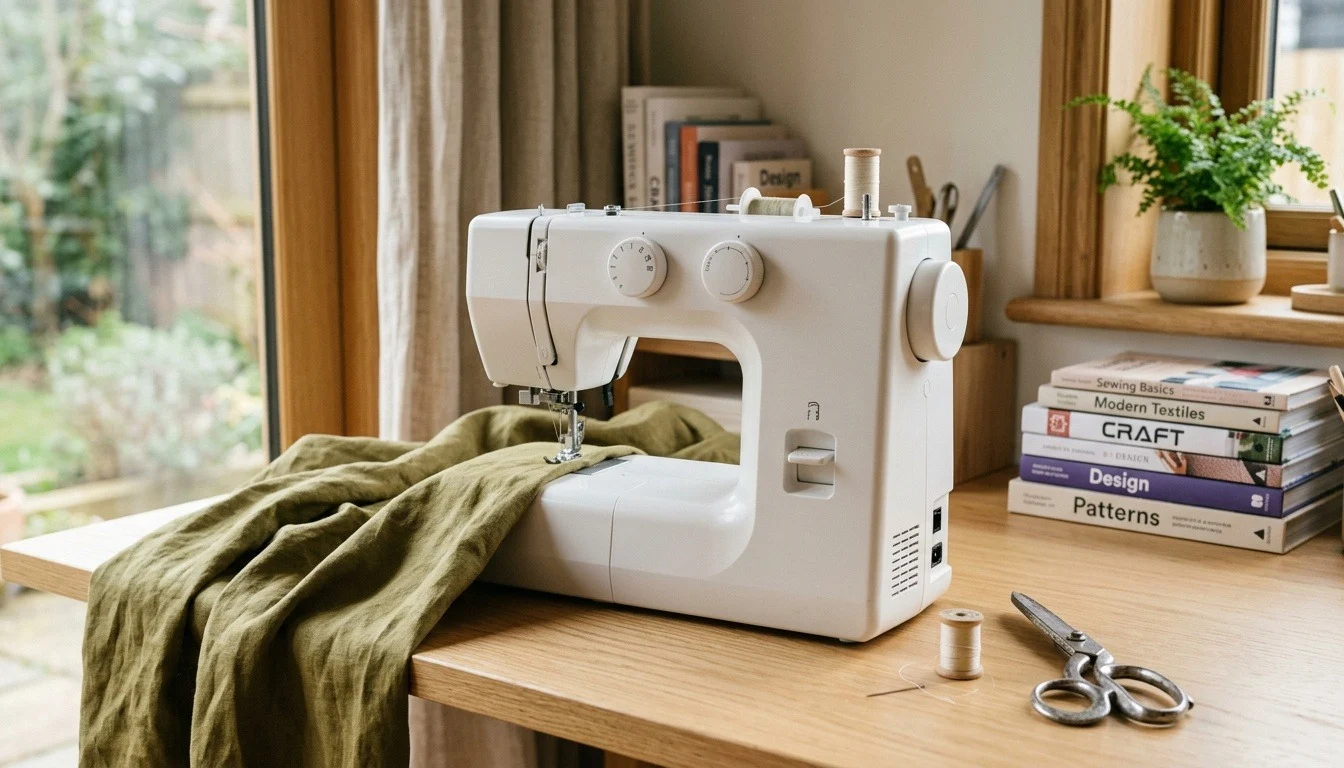
6 Best Sewing Machines for Clothes and Garments in 2026
As an Amazon Associate, this website earns from qualifying purchases.
The short answer
Choose the SINGER 4423 for mechanical garment sewing, Janome HD3000 for adjustable foot pressure, or Juki HZL-DX7 for a broader electronic sewing setup.
Clothes need usable seams, stretch options, buttonholes and access to sleeves as much as decorative stitching. Start with the fabric you sew and the controls you want to learn.
We have not tested these machines. We used opened manufacturer specifications, exact Amazon catalog records and internal product research. Accessories, duplicate packages, unfamiliar makers and industrial machines were removed. The order reflects the project fit explained below; it does not promise measured stitch quality or durability.
#1. SINGER Heavy Duty 4423 Meltwater Blue: mechanical garment sewing
Linked offer is the Meltwater Blue version with accessories
Keep in mind: its high maximum speed is not proof of better sewing through bulky seams.
Product details checked October 2026
The 4423 combines a one-step buttonhole, needle threader and adjustable foot pressure. That is a useful set for ordinary garment construction with dial controls. The linked Meltwater Blue version includes accessories; its color is not evidence of different sewing performance.
#2. Janome HD3000 with hard case: adjustable fabric pressure
Keep in mind: the modest stitch library is less suited to decorative stitch experimentation.
Product details checked October 2026
The HD3000 offers adjustable foot pressure and a one-step buttonhole with 18 stitches. Choose it when utility sewing and control across different project fabrics matter more than decorative menus. Its manufacturer specification resolves an inconsistent stitch count in the retailer catalog.
#3. Brother ST150HDH with sewing thread: electronic stitch choice
Keep in mind: it remains a domestic machine, with no promised number of heavy fabric layers.
Product details checked October 2026
The ST150HDH has 50 stitches, five one-step buttonholes and an LCD. It suits a sewer who wants electronic selection for both everyday seams and occasional heavier fabric. Do not turn the Strong & Tough name into an untested layer-capacity claim.
600 built-in stitches and 13 one-step buttonhole styles
Extension table and walking foot included
Speed control and a start/stop button
Keep in mind: its stitch library takes more learning than a simple straight-stitch machine.
Product details checked October 2026
The 9960 provides 13 one-step buttonhole styles and a large decorative library. This is a fit for cuffs, borders and stitched embellishment as well as construction. Those options make more sense when you plan to use them; the count alone does not justify the learning time.
#5. Brother CS7000X with case, thread and needles: a first garment machine
Linked bundle adds a carrying case, thread and needles
Keep in mind: presser foot pressure is not adjustable.
Product details checked October 2026
The CS7000X brings seven buttonholes, a free arm and ten sewing feet. The linked case, thread and needle bundle also suits someone setting up a first desk. Its fixed foot pressure is worth weighing if you move frequently between very different materials.
Keep in mind: its electronic stitch options take more setup learning than basic dials.
Product details checked October 2026
The linked offer is the HZL-DX7 Quilters Package, with a knee lift, walking foot and free-hand foot listed. Confirm the extension-table contents on that package before ordering; the listing describes the table as optional.
The HZL-DX7 has box feed, a built-in straight stitch plate and 277 stitches. That combination suits someone who alternates careful construction and decorative work. Buy for the controls and feeding arrangement you will use, rather than treating electronic complexity as an automatic upgrade.
Factors to consider before choosing
Match the buttonhole to your clothes. A one-step buttonhole reduces operator stages. The number of buttonhole styles matters only if their shapes suit what you sew.
Think about knits separately. Check the stretch stitches and compatible feet in the manual. A serger is useful for finishing knit seams, but it does not replace the machine used for buttonholes and other garment tasks. Our serger guide explains that purchase.
Use pressure and needle settings together. Fabric feeding depends on the whole setup. A pressure adjustment is a useful control, but neither it nor a heavy-duty label guarantees a particular number of layers.
Keep room for pressing and cutting. Garment making also needs a place to support fabric. Measure the machine, case and any extension table before deciding how much equipment belongs on your desk.
A regular machine can make garments and finish many edges with zigzag or overcast stitches. A separate serger becomes useful for frequent knit sewing and edge finishing.
Does a bigger stitch count make a better garment machine?
No. Buttonhole operation, useful utility and stretch stitches, fabric control and compatible feet are more relevant than the total count.
Which is best for a first sewing setup?
The CS7000X bundle is a practical first setup if fixed foot pressure is acceptable. The 4423 offers mechanical controls with a one-step buttonhole.